

Credit Cards for Building Credit: The Ultimate Beginner’s Guide
Using credit cards for building credit can help you open your first credit line and grow real credit history—without paying a dime in interest. Now, in order to do this, you need a little discipline and to follow a simple, step-by-step plan. You’ll learn when a secured credit card makes sense, how to boost approval odds before you apply, and the one habit that moves your score the fastest. We’ll keep the math light and the actions clear so you can start small, avoid junk fees, and see progress in weeks, not months. And once your foundations are set, explore wealth-building strategies to grow beyond credit.
This guide is not for you if you plan to revolve a balance or ignore autopay. You’ll get plain-English rules for smart utilization (how much of your limit to use), what to do if you have no credit history, and how to pick a starter card that actually reports to all three bureaus. I am not going to give you some nonsense pitch about “guaranteed approval” claims, but I will give you a clean path to your first (or a better) score.
TL;DR: Pre-qualify with a soft inquiry, open one beginner-friendly card that reports to all three bureaus, turn autopay on to the statement balance, and keep utilization low (aim <30%, ideally single-digits) for ~90 days—this habit stack targets the two biggest FICO drivers (payment history 35%, amounts owed 30%) without paying interest.
What you’ll learn:
- Pre-apply checklist: quick moves to raise approval odds and avoid hard-pull waste.
- Secured vs. starter cards: which to choose based on deposit, fees, and reporting.
- 90-day game plan: exactly how to spend, set autopay, and keep utilization low.
Is This Guide Right for You? (Read This First)
If you want a clean, low-stress way to use credit cards for building credit that is no-nonsense and with no revolving balances, then this approach was designed for you. You’ll use one beginner card responsibly, let on-time payments post automatically, and keep your monthly balance light so your credit utilization stays comfortably low. Over ~90 days, those two behaviors do most of the scoring work for beginners, because payment history and amounts owed dominate modern FICO models.
If cash flow is tight and you’d be tempted to carry a balance, pause—building credit should never require paying interest. Come back when autopaying the statement balance is realistic, then choose a card that reports to all three bureaus so your progress shows up everywhere.
Approval-Confidence System: Set Yourself Up for Success Before You Apply
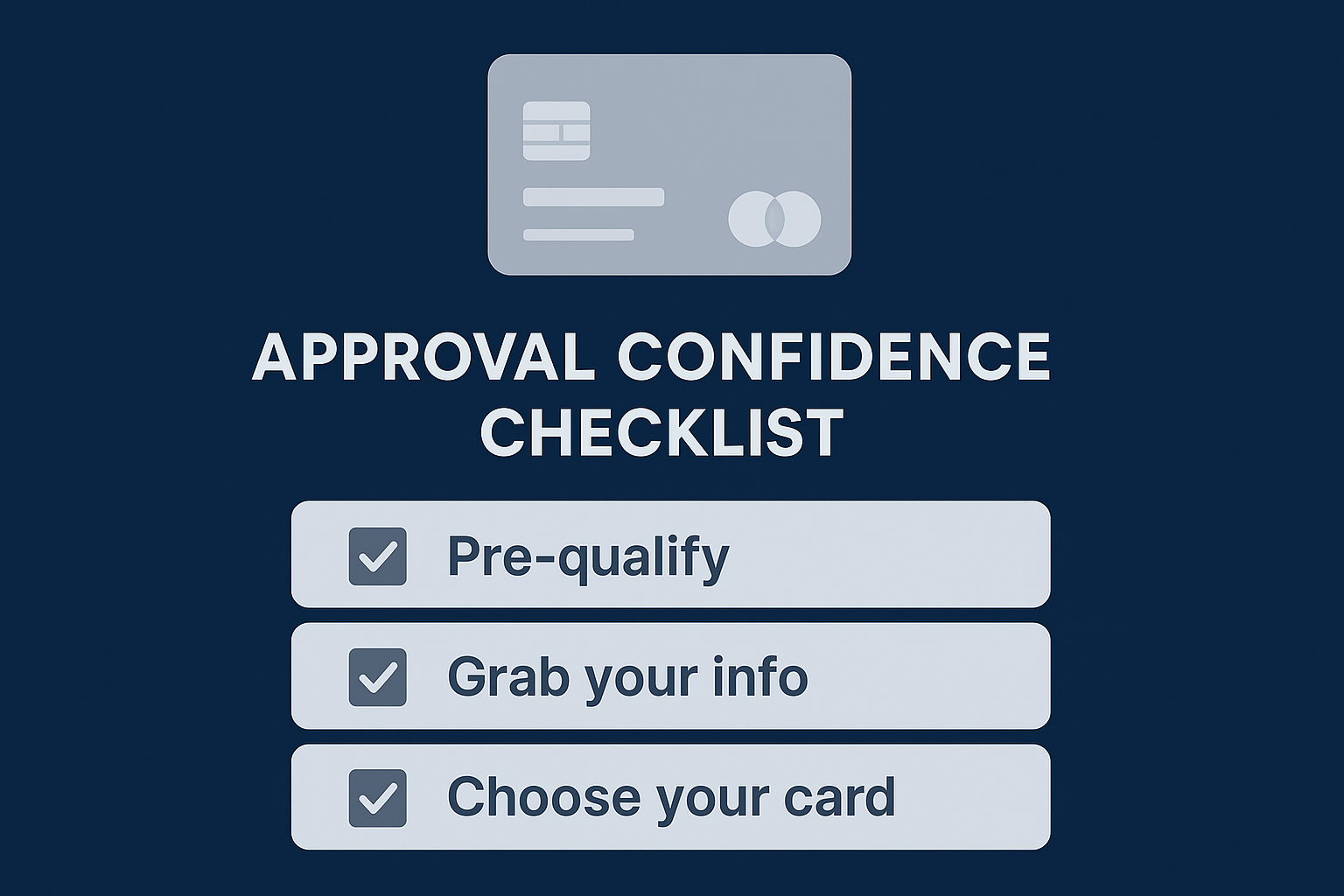
Your goal here is simple: avoid unnecessary hard pulls, pick the right first card, and lock in good habits on Day 1.
1) Pre-qualify With a Soft Pull (no score impact)
Use an issuer’s pre-qualification tool to check likely offers with a soft inquiry. It helps you aim for realistic approvals while avoiding score dings from unnecessary hard pulls.
2) Lock Down Your Info
Have legal name/address, income, and a linked bank account ready so your application is accurate and quick. Small errors trigger slowdowns or extra pulls.
3) Choose the Path that Matches Your Cash Flow
Secured card: You put down a refundable deposit that typically sets your limit; ask the issuer to confirm they report to Experian, Equifax, and TransUnion, and whether/when the account can “graduate.”
No-deposit starter: If tying up a deposit isn’t ideal, consider a starter card using alternative underwriting—still verify bureau reporting.
4) Prioritize Credit Health Day 1
Turn autopay to the statement balance on so every payment posts on time, and you avoid interest entirely. Then keep utilization below 30%, aiming for single-digit use when possible. Set reminders to regularly check statement balances to make sure your account stays in good standing.
5) Bonus tip – For those with Thin Credit Profiles
If your file is still thin, consider becoming an authorized user on a well-managed card or adding rent reporting through a reputable service—use these as supplements, not substitutes for your own credit lines. When I first started with credit cards, I did this with my parents, and it worked well to allow me to begin building credit.
The 90-Day Plan to Build Credit

Day 0–30: Establish Basics
Open one beginner-friendly card (secured or starter), add 1–2 small recurring charges (phone, streaming), and turn autopay to the statement balance so every payment posts on time. Keep what reports to credit bureaus each month very light: aim to have your statement balance be single-digit utilization (under 10% of your limit; e.g., a $300 limit should report ≈$30 or less). This habit stack targets the biggest FICO drivers (on-time payments and amounts owed) without gaming the system or paying fees.
How to Stay Under 10% (Even with a Low Limit)
Let the card run only those small autopay bills and pay mid-cycle once if needed, so the reported balance is still under 10% on statement day. If you accidentally report higher, don’t sweat it—just reset next cycle; utilization is snapshot-based at a specific date each month, not a permanent grade.
Day 31–60: Verify Reporting & Build Depth
By now, you should start seeing some data on your credit reports (it often takes 30–60 days from account opening). Use AnnualCreditReport.com to pull free weekly reports from Experian, Equifax, and TransUnion, and confirm three things: the account appears, the credit limit is correct, and your on-time payment posted. If anything’s missing after ~60 days, call the issuer to request an update.
Build Credit History
You can add depth without extra spending. Consider becoming an authorized user on a well-managed card (low utilization, never pay late) only if that issuer reports authorized user data to the bureaus. This can help beginners establish history, but only if the primary cardholder pays on time and has responsible credit-building habits. If they are sloppy with their card, this can hurt you, so choose carefully. Separately, rent reporting can add positive payment history when your landlord (or a service) reports on-time rent, review fees, and note the impact varies by scoring model, but research shows rent data can improve credit visibility for people with sparse files.
Day 61–90: Prepare for Graduation
If you opened a secured card, this is a good window to raise your deposit (if cash flow allows) to raise your credit limit, which lowers your utilization ratio and cushions you against accidental spikes. Keep the same “light-use + autopay” rhythm so your first three statements show perfect behavior across the two heaviest FICO factors. Then look ahead: many issuers offer a “graduation” from secured to unsecured starting around the 6–12 month mark (e.g., Discover begins automatic reviews at ~7 months, while Capital One notes there’s no fixed timeline and they review periodically). Your job is to stay boring: on-time, low reported balances, and avoid new applications for now, so you’re not dinged by the new credit factor when you’re close to graduating.
The Plan Continued: Month 3–6: Add a Second Credit Line Once You’re Ready
If your first 2–3 statements show on-time payments and low reported balances, you can consider a second, no-fee card to widen available credit and lower your utilization. If you run a side hustle or LLC, opening a business credit card could be a smart option. Utilization is a huge part of your overall credit score (30%), so getting that in a solid spot will do wonders for you over time. You don’t need a ton of cards; most consumers can build strong credit with a couple of well-managed cards. Adding accounts too quickly can ding the “new credit” part of your score, so pace yourself and pre-qualify (soft pull) before any hard inquiry. Keep the same rules: small recurring charges, autopay on, statement balances in single digits relative to the limit.
Another option at the 6-month+ mark is to request a credit line increase. This will help increase your total available credit and, in turn, lower your utilization, as long as your purchases remain the same. Pairing this strategy with opening a second credit line will help you go from beginner to intermediate in the credit-building space fast.
If Anything Looks Wrong, Verify & Dispute
By 30–60 days from opening, your new credit line should appear on Experian, Equifax, and TransUnion. Use AnnualCreditReport.com to check reports weekly for free and confirm that the account, limit, and on-time payment are recorded correctly. If something’s missing after ~60 days, call the issuer to prompt an update. For errors, follow the CFPB’s dispute steps: document the issue, submit a dispute with each bureau that shows the mistake, include supporting evidence, and keep records. The FTC’s guidance aligns with this process and reinforces your right to accurate reporting under federal law.
Heads up: Most issuers report near your statement closing date, so mid-cycle payments can help ensure the balance that reports stays low. Don’t expect instant score updates—each bureau posts on its own cadence.
Secured vs. Unsecured Starter Credit Card: Which Is Right for You?
As you begin your credit building journey, one thought you need to keep in mind is the different options you have. Secured cards are easier to qualify for and offer a predictable path to building credit, but require upfront cash to be used as collateral. No-deposit credit cards are what most people think of when they think of a first credit card. They usually have little to no reward structure, a small credit limit, and are primarily used to build credit history. In either case, confirm the card reports to all three bureaus and keep autopay on so you never pay interest while you build.
A secured card offers you the simplest form of credit building: you place a refundable deposit that usually sets (or helps set) your limit, then use the card like any other. Used responsibly, many issuers conduct periodic reviews and may upgrade you and return the deposit. Discover begins automatic reviews around month seven; Capital One allows low-entry deposits that can unlock a higher starting line.
Secured Credit Cards for Building Credit – Pros & Cons
| Pros | Cons |
| – Best approval odds for new or poor credit scores – Builds credit history | – Requires liquid cash to be used as collateral – Lower starting credit limits – Little to no rewards structure |
Starter Unsecured Credit Cards for Building Credit – Pros & Cons
| Pros | Cons |
| – No security deposit – Builds credit – Access to some rewards – Access to some consumer protections (disputes) | – More difficult to be approved for new or poor credit scores – Rewards can be restricted or devalued – Requires careful management to avoid interest |
Below is a list of some of the best secured and unsecured cards to start with. Before applying, I highly suggest you download my credit card application checklist. It will give you a step-by-step look at everything you need to take into account before applying. You can get it here.
Starter & Secured Card Matrix
| Card Type | Annual Fee | Deposit / Limit | Graduation / Upgrade | Typical Credit* | Notes |
|---|---|---|---|---|---|
| Secured Discover it® Secured | $0 | $200+; limit≈deposit | ~7 mo reviews; possible upgrade | No score req. | Reports to 3; rewards; terms apply. |
| Secured Capital One Platinum Secured | $0 | $49/$99/$200→$200+ line | Periodic reviews | No score req. | Reports to 3; low entry deposit. |
| Secured OpenSky® Secured Visa® | $35 | $200+; no credit check | ~6 mo review | Poor / none | Reports to 3; watch fees. |
| Secured-style Chime® Credit Builder | $0 | Linked account sets limit; no check | N/A | No check | Reports to 3; utilization not reported; terms apply. |
| Unsecured Petal® 2 | $0 | No deposit; cash-flow underwriting | N/A | Thin / fair | Reports to 3; strong starter. |
| Unsecured Chase Freedom Rise® | $0 | No deposit; $250+ Chase balance can help | ~6 mo CLI; path within issuer | No history OK | Reports to bureaus; terms apply. |
Common Traps to Avoid When Using Credit Cards for Building Credit
Junk Fees and High-Cost Pricing
Watch out for “program,” “monthly maintenance,” and other add-on charges that quietly eat into your limit and budget. Private-label and subprime cards are more likely to layer fees and push costlier behavior; the CARD Act curbs the worst “fee-harvester” setups by limiting total first-year fees relative to your credit limit—but costs can still stack if you’re not reading the fine print. To build credit, keep it simple: look for $0 or low annual fee, no monthly junk fees, and clear reporting to all three bureaus.
“No Interest if Paid in Full” (Deferred-Interest) Promos
Retail cards often market “no interest if paid in 12 months“. I dive into this in greater detail in my post on the best credit cards for large purchases, if you are looking for more information. Long story short, the “if” matters. Miss repayment by even a dollar or a day, and the issuer can add retroactive interest back to the purchase date, turning an optimistic promo into an expensive surprise. Look for true 0% intro APR (interest waived, not deferred), or set a payoff plan that clears the full promo balance before the clock runs out.
Stacking Multiple Applications
Each new application creates a hard inquiry, which can ding scores briefly—and several in a short window signal risk. Use a pre-qualification (soft pull) first, pace applications (e.g., one at a time with 60–90 days between), and keep utilization low so you don’t need new credit to float expenses. Mortgage/auto/student loan “rate-shopping” rules don’t apply the same way to credit cards, so avoid rapid-fire submissions.
Next Steps You Can Take Today
Bottom line: Building credit is intentionally boring—and that’s the point. Open one beginner-friendly card, turn on autopay to the statement balance, and hold your utilization to single digits. These habits compound payment history (35%) and amounts owed (30%)—the two heaviest FICO factors—without ever paying interest.
- Download the Approval-Confidence Checklist: It will prep you for everything you need to keep in mind in five minutes and allow you to avoid unnecessary hard pulls.
- Find the card that’s right for you and look to pre-qualify (soft check) before any application to target realistic approvals.
- Set autopay and keep interest at $0 when you pay in full each month.
- Start the 90-day plan: run light charges, report <10% on statement day, and reassess after three on-time cycles.
FAQ
Yes—when the issuer reports to the credit bureaus and you pay on time. Most mainstream secured cards report; still, always confirm three-bureau reporting (Experian, Equifax, TransUnion) before you apply. Then set autopay and use lightly so positive data posts monthly.
With consistent on-time payments and low balances, many beginners see movement in roughly 6–12 months. Your timeline varies by profile (thin file, recent negatives, utilization), but the habit stack—pay in full, keep balances small, avoid new hard pulls—does the heavy lifting.
Aim below 10% of your credit limit at statement cut; lower is better. FICO’s guidance supports staying under 10%, and analyses of strong credit profiles show they average around ~7% utilization—proof that small balances (or $0) are ideal for scoring.
It can help—but results vary by lender and model. Many issuers report AU accounts, which may aid thin files; however, not every scorecard weighs AUs the same.
This is not financial advice and is meant for educational purposes only. Read my disclosure page for more information. Always pay credit cards in full and note that terms apply. The views expressed in this post and on this website are my own.
1 Comment
Comments are closed.