

AAA Daily Advantage Visa Signature Credit Card: The Better AAA Pick
Anytime a no annual fee card pays 5% cash back in a category you actually use every week, it belongs on your radar. AAA has two of them. The AAA Daily Advantage Visa Signature Credit Card pays 5% on groceries. Then the AAA Travel Advantage Visa Signature Credit Card pays 5% on gas and EV charging.
Both are worth a look, but they aren’t equal, and the reason isn’t the headline rate. It’s the cap. The Daily Advantage covers a wider slice of a normal budget, and its earning cap is easier to reach. Because of that it wins for most people, even when you build the comparison around a heavy driver. AAA also tightened both cards’ bonus category definitions in May 2026, and that change matters more than most people realize.
When most people think AAA, they think roadside assistance. Not credit cards, and definitely not elite cash back earners. For all my basketball fans out there, these aren’t the Michael Jordans of your wallet. They’re more like the Scottie Pippens. Probably not the card you build your whole wallet around. But they can be the piece that makes the rest of it work a lot better.
Key Takeaways:
- The Daily Advantage earns 5% on groceries and 3% on gas, EV charging, wholesale clubs, streaming, pharmacies, and AAA purchases, with no annual fee.
- Cash back is capped at $500 per calendar year across groceries, wholesale clubs, and gas combined, which supports about $10,000 of grocery spend or roughly $833 a month.
- The Travel Advantage earns 5% on gas and EV charging but caps that category at $350 a year, so you’d need about $7,000 in annual gas to max it out.
- On a heavy-driver budget of $600 a month in gas, the Travel Advantage still only wins by about $16 a year. For most other budgets the Daily Advantage wins outright.
| AAA Daily Advantage Visa Signature | AAA Travel Advantage Visa Signature | |
|---|---|---|
| Annual fee | $0/yr | $0/yr |
| Top earn rates | Groceries 5% · Gas & EV 3% · Wholesale Clubs 3% | Gas & EV 5% · Travel 3% · Restaurants 3% |
| Top partners | None | None |
| Card network | Visa Signature | Visa Signature |
| Foreign tx fee | 0% | 0% |
| Apply Now → | Apply Now → |
Annual fee
Top earn rates
Top partners
Card network
Foreign tx fee
AAA DAILY ADVANTAGE VISA SIGNATURE
Apply Now →AAA TRAVEL ADVANTAGE VISA SIGNATURE
Apply Now →Terms apply. Some links are affiliate links. Credit card comparisons assume you pay your balance in full every month. Offers shown reflect what was current at publication date.
What the AAA Daily Advantage Visa Signature Credit Card Earns
Want to run this math on your spending? Plug in your real numbers and see what each card actually earns you.
Free Calculator →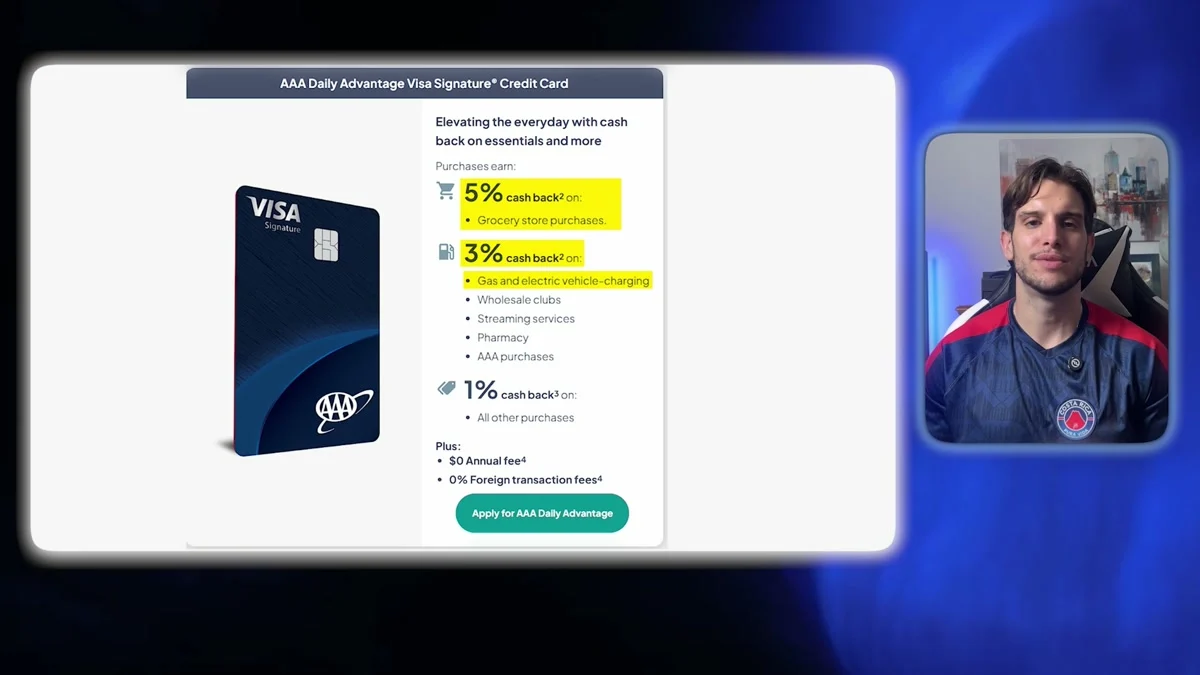
The Daily Advantage pays 5% back on grocery store purchases, which is already strong for a card with no annual fee. Then it adds 3% back on gas and EV charging, wholesale clubs, streaming services, pharmacies, and AAA purchases. After that, everything else earns 1%.
That second tier is the part that makes this more than a grocery card. Groceries, wholesale clubs, gas, pharmacies, streaming. Nothing flashy, just solid multipliers across the stuff that hits your statement every single month. So to me this is really a household spending card. And that’s more useful to own than a card with one great category and nothing behind it.
Now, the sneaky part for me is that wholesale club category. A lot of grocery cards don’t treat wholesale clubs the way they treat traditional supermarkets. So if you shop at Costco, Sam’s Club, or BJ’s, a card that pays 3% there can be a useful extra layer.
And there’s no annual fee or foreign transaction fees on either card. Both currently offer the same welcome bonus: a $100 statement credit after you spend $1,000 in the first 90 days.
Want free tools to run the numbers on your own card setup? I built a toolkit for exactly this.
Grab the free Rewards & Returns Toolkit
The $500 Cap Is the Part Everyone Skips

On paper those multipliers look unbeatable. But that’s until you realize there’s an earning cap.
The Daily Advantage has a $500 calendar year cash back cap across groceries, wholesale clubs, and gas stations combined. Once you hit it, those categories drop to 1% for the rest of the year.
If you earned that entirely through the 5% grocery category, $500 in cash back supports about $10,000 of annual grocery spend. That works out to roughly $833 a month. Because the cap is shared across the 5% and 3% categories, your exact limit shifts depending on how you spend.
Is the cap great? No. But compared to a lot of the other 5% cards out there right now, it’s better than most. For example the Citi Custom Cash, which Citi closed to new applicants back in May, caps its 5% at $500 per billing cycle, which is $300 a year if you max it perfectly. Getting to $500 here takes a lot of grocery volume. But once you understand how the cap interacts with your own spend, you can layer one or two other cards behind it.
That’s when the Daily Advantage really starts to become the anchor of a strong cash back setup.
What Changed in May 2026
This is the change that matters most right now. If this card looked great to you last year, it might not fit your budget the same way today.
Effective May 15, 2026, AAA tightened the bonus category definitions on both cards. Cardholders were notified by email earlier in the year. Two things changed:
The 5% grocery category on the Daily Advantage is now limited to supermarkets and grocery stores. Discount stores, superstores, and convenience stores no longer qualify. In practice that means Walmart and Target grocery runs likely won’t earn the 5% anymore.
Gas bonuses on both cards are now limited to traditional standalone gas stations. Fuel bought at supermarkets, superstores, and warehouse clubs is excluded. And cardholders have specifically reported that Costco gas stopped coding for the Travel Advantage’s 5% rate after the change.
So if you buy most of your groceries at Walmart, or you fill up exclusively at Costco, that changes what these cards are worth to you. Some AAA clubs, including Auto Club Group, also aren’t participating in the higher AAA purchase bonus, so your club region matters. These details came through issuer emails and cardholder reports, not a press release. So check the current rewards terms for your own club before you apply.
The AAA credit card benefits do go a little past the cash back too. Hertz purchases earn 4% on the Travel Advantage and 2% on the Daily Advantage. Small, but if you rent from Hertz with any regularity it could be a tiebreaker.
The AAA Travel Advantage Visa Signature Credit Card
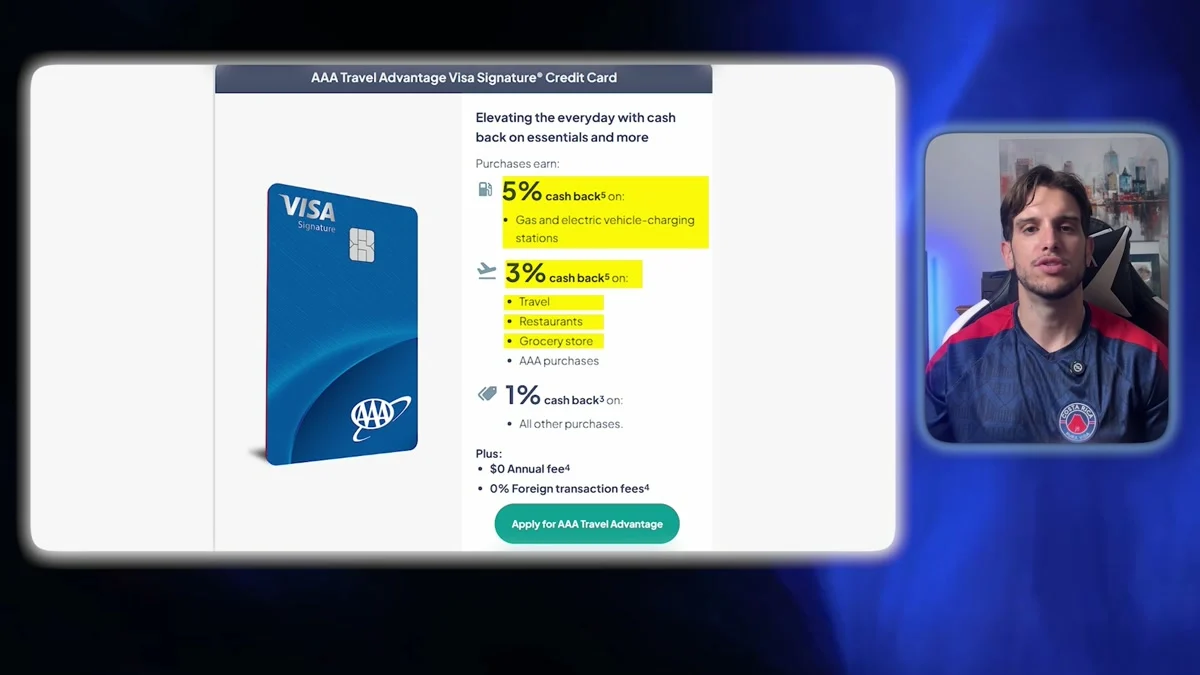
The Travel Advantage is built for a different spender entirely. It earns 5% back on gas and EV charging, then 3% back on groceries, restaurants, travel, and AAA purchases, with 1% on everything else.
I’m not about to poo-poo this card. A no annual fee card earning 5% on gas and EV charging can absolutely earn a place in some people’s wallets. It’s just more situation-dependent. You really need to be crushing gas and driving a ton for this one to do real damage. Or you need to be supporting a household with multiple drivers.
Now, those 3% categories do help here. Restaurants, travel, and groceries make this card more versatile than a basic gas card. So if your setup is weak in any of those, this one could still fill the gap while also covering your fill-ups.
But that cap matters even more here, because the card only shines if your gas spending is high enough to make that 5% do something.
The $350 Gas Cap, in Driving Terms
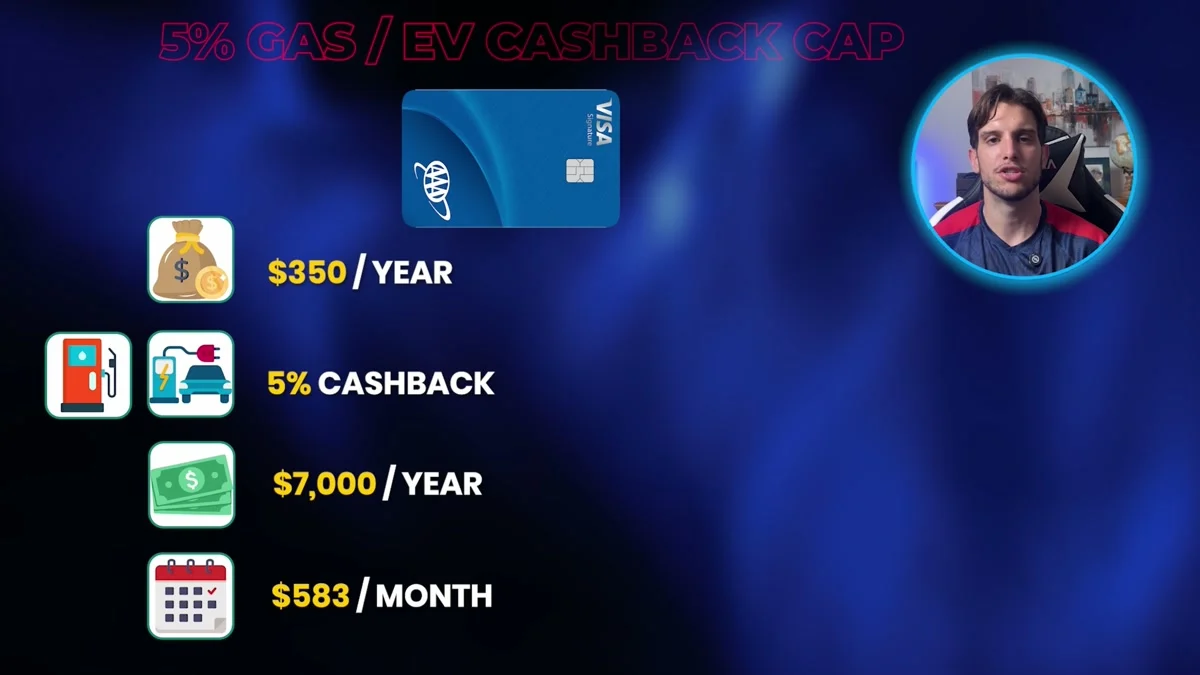
The Travel Advantage caps cash back at $350 per calendar year on the 5% gas and EV charging category. At 5%, maxing that out takes about $7,000 a year in gas, or roughly $583 a month.
AAA’s own national average for regular gas sits at about $4.07 a gallon as of August 18, 2026. So $583 a month is somewhere around 143 gallons. If your household averages 25 miles per gallon, that’s roughly 3,500 miles a month, or about 43,000 miles a year.
For a single commuter, that number is probably out of reach. But if your household runs three drivers, or you’re constantly driving for work, it’s completely realistic. That’s the main story on this card. I don’t think it’s a bad card at all, it’s just more targeted.
AAA Daily Advantage vs Travel Advantage
Most people I work with find $300–$800/year in missed rewards from one wrong card or one misassigned category. I map your real spending and build a custom plan in a 30-minute call.
Not financial advice. Results vary by individual spend.
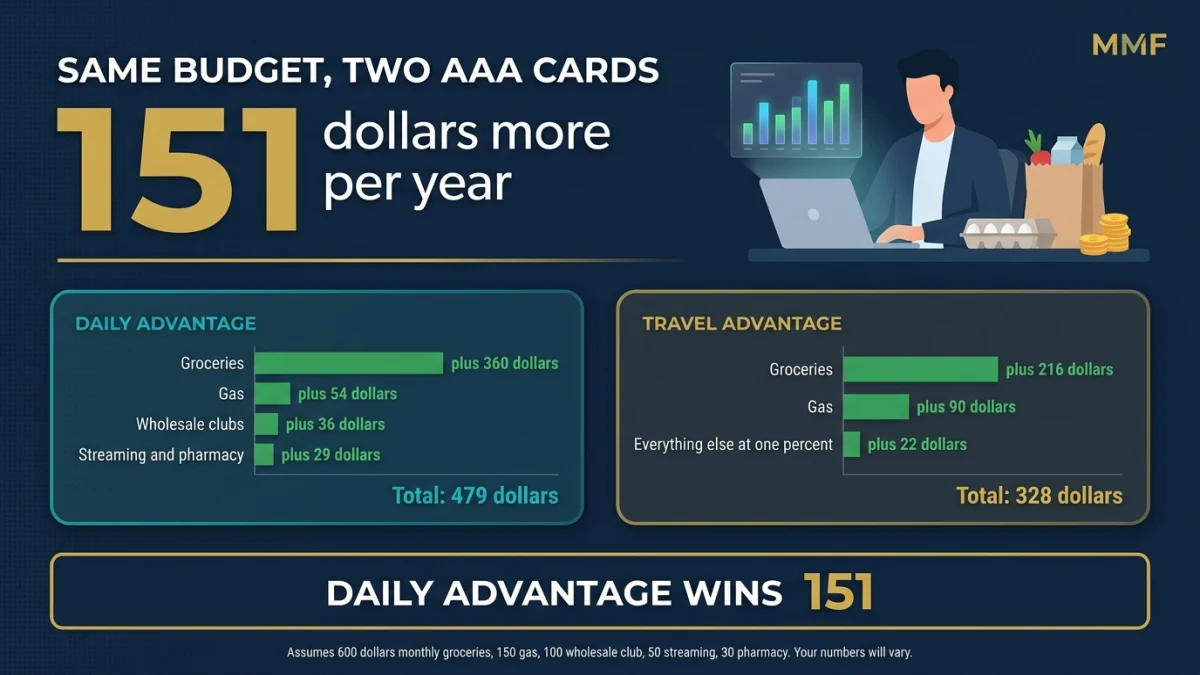
Tables help, but your own budget is what decides this. So let’s put the same household through both cards.
Say you spend $600 a month on groceries, $150 on gas, $100 at a wholesale club, $50 on streaming, and $30 at the pharmacy. That’s a fairly normal setup for a couple or a small family.
On the Daily Advantage, groceries earn $360, gas earns $54, the wholesale club earns $36, streaming earns $18, and the pharmacy earns about $11. Your capped categories total $450, so you stay under the $500 ceiling. Call it $479 for the year.
On the Travel Advantage, that same budget earns $90 on gas, $216 on groceries, and 1% on the wholesale club, streaming, and pharmacy spend. That’s about $328.
Same spend, both cards. Daily Advantage pays about $479 a year. Travel Advantage pays about $328. That’s a $151 gap in favor of the Daily Advantage on identical spending.
Even the Heavy Driver Case Is Close
Now, you’d expect the Travel Advantage to win here comfortably once the gas spend climbs, but it doesn’t.
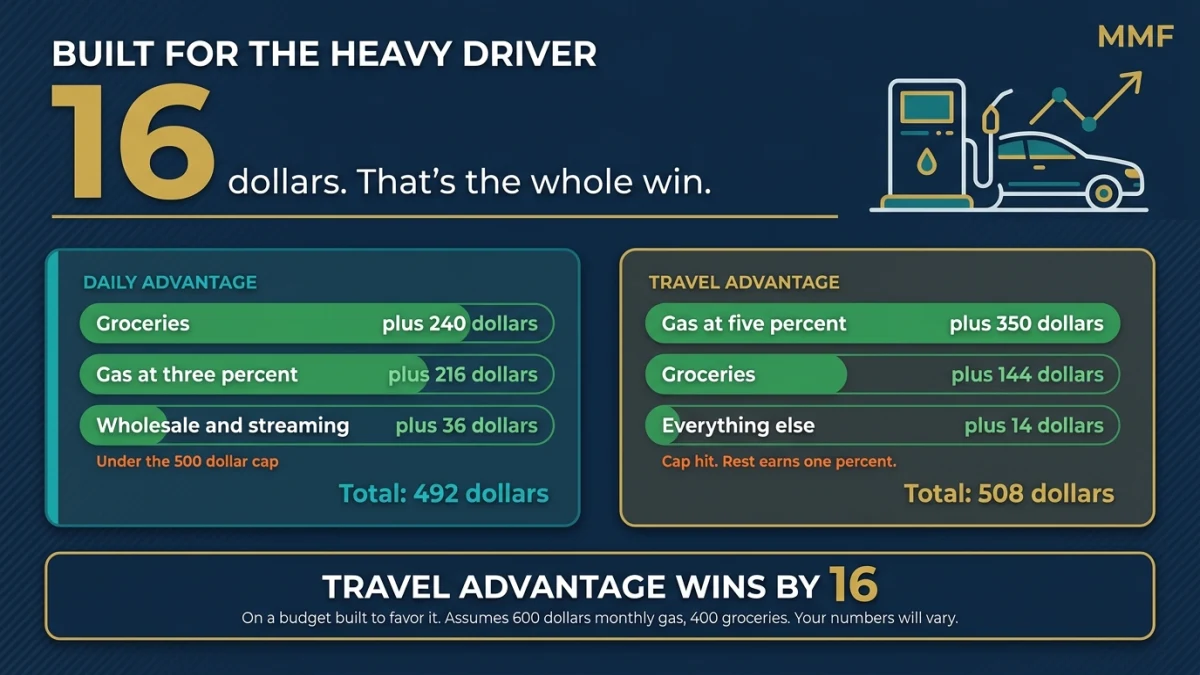
Take a genuine heavy driver: $600 a month in gas, $400 on groceries, $50 at a wholesale club, $50 on streaming.
The Daily Advantage earns $240 on groceries, $216 on gas, and $18 at the wholesale club. That lands at $474 in capped categories, so you stay under the ceiling. Add $18 in streaming and you’re at $492.
The Travel Advantage earns 5% on the first $7,000 of gas for $350, then 1% on the remaining $200 for $2. Groceries add $144, and the wholesale club and streaming earn 1% for $12 combined. That’s $508.
On a budget built specifically to favor it, the Travel Advantage pays $508 against the Daily Advantage’s $492. That’s a $16 win, on $7,200 of annual gas.
That’s the case for the Daily Advantage in a nutshell. Its 5% category is the one most households spend more in. And because its 3% tier still pays on the gas anyway, the gap the Travel Advantage has to close is bigger than it looks. For the Travel Advantage to win by a clear margin, you’d need that heavy gas spend paired with a small grocery bill or a secondary grocery card.
But don’t just take my word for it. Map out your spend and run your own numbers. Your split could easily land differently than mine.
Building a Stack Around the Daily Advantage
The cap is what makes this a stack card rather than a solo card. Once you know roughly where your grocery spend tops out, you can build around it.
One setup that would cook here: the AAA Daily Advantage for groceries, wholesale clubs, and gas, then the Capital One Savor for 3% on dining and entertainment. Behind those you want a strong catch-all. If you’re already paying for Robinhood Gold, that card’s 3% works, and if you’re not, the Fidelity Rewards Visa pays a flat 2% and is a solid alternative.
That gives you 5% on groceries, 3% on gas and wholesale clubs, 3% on dining and 2% or 3% on everything else. No travel portals, no transfer partners, no trying to justify a premium travel card when you take one or two trips a year. Just high cash back in categories you actually spend in.
For someone who wants a simple but optimized wallet, that’s a hard setup to beat. And if you’d rather your catch-all earn points you can transfer later, look at the Wells Fargo Autograph. It pairs cleanly with either AAA card and still costs nothing to hold. If you want the wider view on how many cards this kind of setup actually needs, my four-card breakdown covers it.
Every number above runs on my assumed budget, and your grocery-to-gas split is the whole ballgame on these two cards. Most people I work with are leaving somewhere between $300 and $800 a year on the table from category mismatches on cards they already carry. If you want someone to look at your actual statements and map the stack around them, that’s what the Spend Audit ($97) is for.
Best For / Not For
Best for:
- Households spending $400 or more a month at actual supermarkets
- Costco, Sam’s Club, and BJ’s shoppers who want a card that pays on wholesale clubs
- Anyone who wants a no annual fee anchor for a pure cash back setup
- People who’d rather bank straightforward cash back than manage points and transfer partners
Not for:
- Anyone buying most of their groceries at Walmart or Target, since superstores stopped qualifying for the 5% in May 2026
- Heavy drivers with a small grocery bill, where the Travel Advantage could edge ahead
- People who want travel perks, lounge access, or transferable points
- Anyone carrying a balance, because the interest wipes out the rewards. Pay that off first before chasing cash back.
AAA Daily Advantage Visa Signature Credit Card FAQs
Do you need a AAA membership to get the card?
Based on the current published card agreements, active AAA membership doesn’t appear to be a stated requirement to apply for or hold either card. Even so, these products are marketed through AAA and some benefits only pay off if you’re a member. Membership requirements have also differed on older AAA cards, so check the application page for your club before you apply.
What is the cash back cap on the AAA Daily Advantage?
Cash back is capped at $500 per calendar year across grocery stores, wholesale clubs, and gas stations combined. After you hit it, those categories earn 1% for the rest of the calendar year. Because the cap is shared, the exact spend it supports depends on your mix, though $10,000 of pure grocery spend is the clean benchmark.
Does Walmart count for the 5% grocery category?
Not since May 15, 2026. AAA limited the 5% grocery category to supermarkets and grocery stores, and specifically excluded discount stores, superstores, and convenience stores. If Walmart or Target is where most of your grocery budget goes, this card gets a lot less interesting for you.
Can you have both AAA cards?
Cardholders have reported holding both, though approval and eligibility can vary by AAA club and by Comenity’s own rules. In practice there’s limited reason to carry both. The categories overlap heavily, and each cap is tracked separately on rates most people won’t max out anyway.
Which AAA card is better?
For most people, the Daily Advantage. Its 5% category covers groceries, which is where more households spend, and its 3% tier still pays on gas. The Travel Advantage makes more sense if you’re running very high gas spend against a modest grocery bill.
Both of these AAA cards are stronger than a lot of people give them credit for. If I had to pick one, I’m taking the AAA Daily Advantage all day. That 5% on groceries plus 3% on wholesale clubs is too strong to pass on. And since you still get decent coverage on gas at 3%, it’s close to a no-brainer for the majority of people. The Travel Advantage isn’t a bad card, it just has a very clear lane, and that lane requires a lot of driving.
The real takeaway isn’t to go grab whichever card I picked. It’s to look at where your setup is weakest and fill that gap first. If groceries are the hole, this is one of the better no annual fee options you can get right now. And when groceries are already covered and you’re burning $600 a month in gas, the other one deserves a look. For a no-fee card that pairs with either one, my Wells Fargo Autograph review is the next stop.
Just confirm the current category definitions with your own AAA club first. The May 2026 changes narrowed the bonus categories on both cards.
Which one fits your budget better, the grocery card or the gas card? Drop your split in the comments.

AAA Daily Advantage Visa Signature
5% groceries, 3% gas/wholesale clubs/streaming/pharmacy. $500/yr cash back cap across groceries, wholesale clubs and gas combined.
$0/yr
AAA Travel Advantage Visa Signature
5% gas and EV charging, 3% travel/restaurants/groceries. $350/yr cash back cap on the 5% category.
$0/yr
Capital One Savor Rewards
3% dining, entertainment, grocery, streaming. 8% via C1 Entertainment. No annual fee.
$0/yr
Fidelity Rewards Visa Signature
Flat 2% cash back on everything, deposited directly into a Fidelity account. $100 Global Entry or TSA PreCheck credit every 4 years. Auto rental CDW up to $75K. No annual fee, no foreign TX fees, no reward caps or expiration.
$0/yr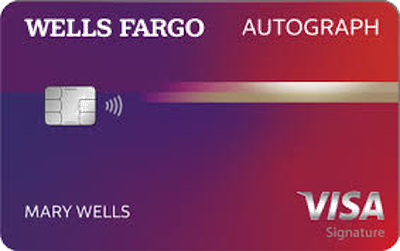
Wells Fargo Autograph
3x on restaurants, travel, gas, transit, streaming, phone plans. Transfer partners.
$0/yrTerms apply. Some links are affiliate links. I only recommend products I personally use or genuinely believe will help you. Pay your balance in full.
Some links are affiliate links. I only recommend products I personally use or genuinely believe will help you. Card terms, earn rates, and bonus category definitions change, and AAA club participation varies by region, so confirm current terms with your own club before applying. Terms apply. Pay your balance in full. Applying for a credit card results in a hard inquiry. I’m not a financial advisor or CPA. This is personal experience and opinion.
Join the discussion
Prompt
What's your experience with this card or strategy? Share your numbers.
Be the first to share your numbers
Real datapoints from the comments make this thread more useful than another review post.
Leave a comment