

How Many Credit Cards Should You Have? My 2026 Setup
Experian’s latest numbers put the average American at 7.1 credit cards open but only 3.7 of them active. Now let that stew for a second, because it’s most of the answer already. The typical person isn’t carrying too many cards. They’re carrying cards that stopped having a purpose and never got dealt with.
I carry four as my day to days and a few others for special situations. But where credit cards can be extremely powerful is when you have the right strategy in place. Through the first half of 2026 I pulled in about $8,100 from credit cards, bank accounts, and shopping portals. Close to none of it came from those four cards.
So the right number isn’t really a number. It’s two questions a lot of people mash into one. How can you optimize your spending, and how many welcome offers can you absorb without torching your approval odds for the next two years?
Key Takeaways:
- Four cards cover every category I spend in. A fifth wouldn’t move my everyday return much, and I’d still open one for the right welcome offer.
- About $8,100 in value through the first half of 2026: roughly $4,000 from three welcome bonuses, $2,600 from bank account bonuses, and about $1,490 from shopping portals.
- Category multipliers contributed almost none of that itemized total. Multipliers are the floor of a setup, not the engine.
- Chase’s 5/24 rule is the hard cap on how many cards you can open. I’m at 3/24 and I’m planning around that, not around some ideal card count.
How Many Credit Cards Should You Have?
Want to run this math on your spending? Plug in your real numbers and see what each card actually earns you.
Free Calculator →Most people are well served by three to five core credit cards: one flat-rate catch-all plus two to four category cards that match where their money is already going. Contrary to popular belief there’s no credit score penalty for holding more. Actually it’s the opposite. If managed responsibly more cards usually equals a lower utilization rate and thus a better credit score. The keys that matter are can you get approved for cards, can you pay your balances in full every month and, if you want Chase cards, the 5/24 rule.
Now that’s the short version. The longer one is that “how many cards” is the wrong unit of measurement, because it treats every card as if it does the same work. For me, two different things are going on in my wallet.
The first is everyday coverage. Coverage is boring, and it’s mostly solved once you’ve got a catch-all plus your top two or three categories accounted for. For me that’s four cards, though I could argue it down to three without losing much.
The second is velocity: how fast you’re opening new accounts to capture welcome bonuses, and that’s where the money is. It has nothing to do with how many cards sit in your wallet today, and everything to do with your 5/24 count, your income, and whether you’ve got natural spending coming up.
If you want free tools to run the numbers on your own card setup, I built a toolkit for exactly this.
Grab the free Rewards & Returns Toolkit
The Four Cards I Carry Every Day
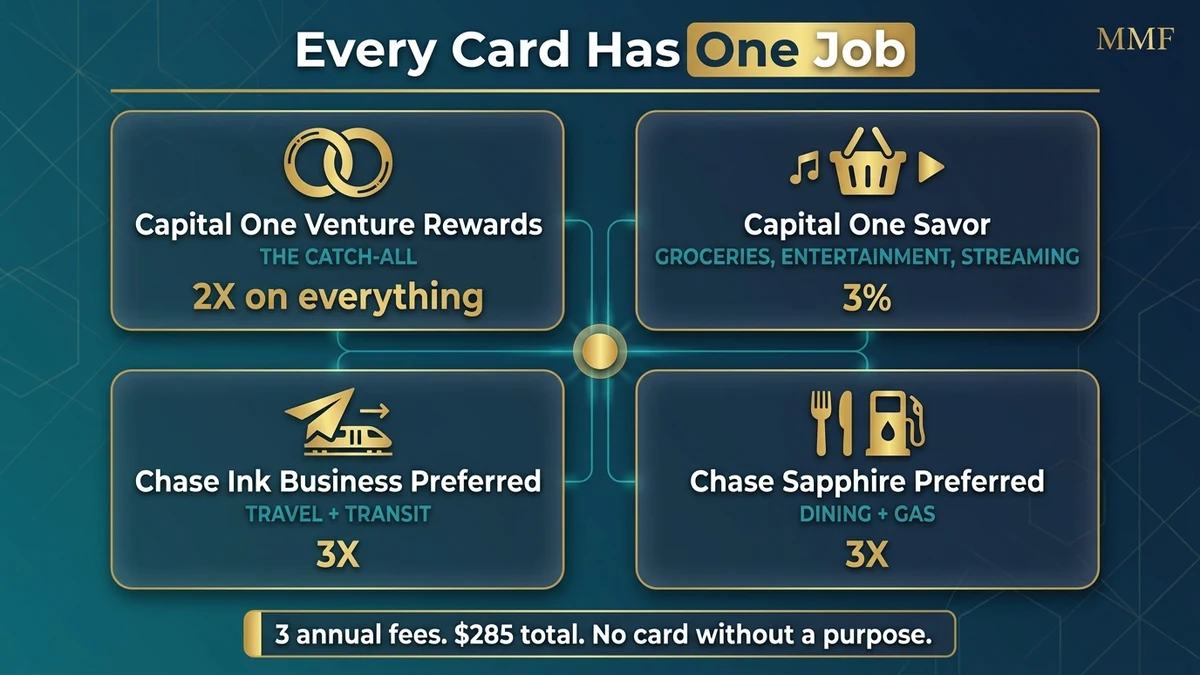
For my wallet and strategy I always need to remind myself, every card has 1 job. When a card stops having a job, it either gets downgraded or cancelled at the annual fee. If it’s a no annual fee card then normally I’ll keep it open.
Capital One Venture Rewards: the catch-all
The Venture Rewards catches all the extra spend my category cards don’t. It earns a flat 2X Capital One miles on basically all spending. And an important note here is that those are transferable miles, not cash back stuck in a portal.
I picked it up a few months back mainly as a welcome bonus play for the 75,000-mile welcome bonus plus the $250 travel credit. But there was a second reason too. About $200 in cash back had been parked on my Capital One Savor for months and I refused to cash it out, so I sat on it like a troll until I could get a Venture card and turn the whole thing into miles.
Now, is a 2X catch-all worth a slot when a 2% cash back card is free? Fair question. For me it comes down to whether you’ll use transfer partners and the synergy it has with other cards in your stack. If you won’t use transfer partners and you got a random card earning a fee, take the free 2% and skip the mid tier travel card here.
Capital One Savor: groceries, entertainment, streaming
The Savor handles 3% on groceries, entertainment, and streaming. It pairs with the Venture so that cash back can become miles instead of a statement credit, which is one of the main reasons I like the Capital One ecosystem more than most people do.
Now I got to say this card is such a sleeper. Especially on that entertainment spend. I put roughly $1,200 of concert tickets on this card and got 3% back, which was solid. Even with that it still stung a little, because Capital One Entertainment would’ve paid 8% on the same purchase if the venue had been in the system. Small music festival so its all good, we move.
Chase Ink Business Preferred: travel and transit
The Ink Business Preferred is the one I call the hidden gem of this set up. It’s the only Chase card earning 3X on general travel booked anywhere, not just through the portal. For $95 that’s tough to argue with. The Sapphire Reserve pays more on flights and hotels booked direct, but everything else that codes as travel now earns 1X with that card. Living in New York, my travel is mostly metro cards and train tickets, so that difference is worth real money to me. The 3X runs on the first $150,000 in combined bonus categories per year, which isn’t a cap most people will hit.
Now the part that matters more than the multiplier: it’s a business card, so it doesn’t eat a 5/24 slot. That’s the whole reason it sits where it does in my setup. If you’re weighing which Chase business card to start with, I broke that down in the Ink Cash vs Ink Unlimited comparison.
Chase Sapphire Preferred: dining and gas
Restaurants are honestly the only reason this one stays in my everyday rotation. After the recent changes it also picked up gas at 3X, which knocked my PayPal debit card out of that slot.
I’d planned to downgrade this to an OG Freedom the moment I got the Ink Preferred. Then the Preferred changes came through and I kept it one more year. I wrote up that whole decision in the Sapphire Preferred downgrade breakdown if you’re staring at the same call.
So that’s the core. A clean 2X to 3X across every category I spend in, 3 annual fees totaling about $285, and every card has a dedicated purpose.
Where the $8,100 Actually Came From
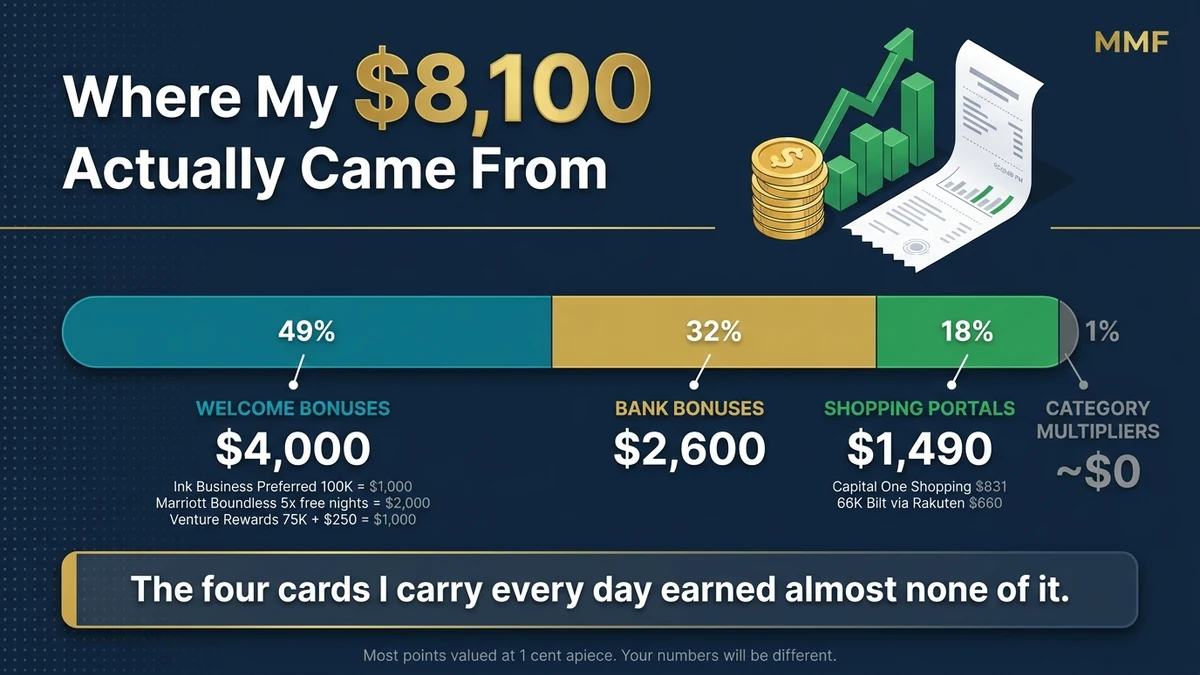
This is the part that reframed the whole question for me. Here’s every dollar of it, with most points valued at a flat 1 cent apiece.
| Source | Value | Type |
|---|---|---|
| Ink Business Preferred, 100K welcome bonus | ~$1,000 | Welcome bonus |
| Marriott Bonvoy Boundless, five 50K free night awards | ~$2,000 | Welcome bonus |
| Capital One Venture Rewards, 75K miles + $250 credit | ~$1,000 | Welcome bonus |
| Bank account bonuses | $2,600+ | Bank bonus |
| Capital One Shopping | ~$831 | Shopping portal |
| ~66,000 Bilt points via Rakuten | ~$660 | Shopping portal |
| Total | ~$8,100 |
Three welcome bonuses came to about $4,000, or roughly half the total. Bank bonuses added $2,600, which is about 32%. Shopping portals brought in around $1,490 between Capital One Shopping and Rakuten, call it 18%. Category multipliers on my four everyday cards contributed almost none of that itemized total.
Read that last line again, because it’s the actual answer to how many cards you should have. My four-card setup earned almost none of the $8,100. The sign up bonuses and my overall strategy did.
Now I want to be fair about what that does and doesn’t mean. It doesn’t mean multipliers are worthless. What it means is that at my spending level, multipliers won’t move the needle. Eventually the bonuses dry up and the core setup has to do the heavy lifting, which is the whole reason I keep coverage tight even though it isn’t where the money is today.
One more note on that number. Valuing everything at 1 cent is conservative on purpose, because I’m not cashing out points at a penny. The true travel value is a decent bit higher. I’d rather understate it than sell you a number that’s tough to defend.
That $8,100 assumes my spending, my city, and three approvals that lined up. Yours won’t match. Most people I work with are leaving somewhere between $300 and $800 a year on the table just from category mismatches on cards they already carry. If you want me to look at your actual statements and map it out, that’s what the Spend Audit ($97) is for.
The 5/24 Rule Decides Your Card Count
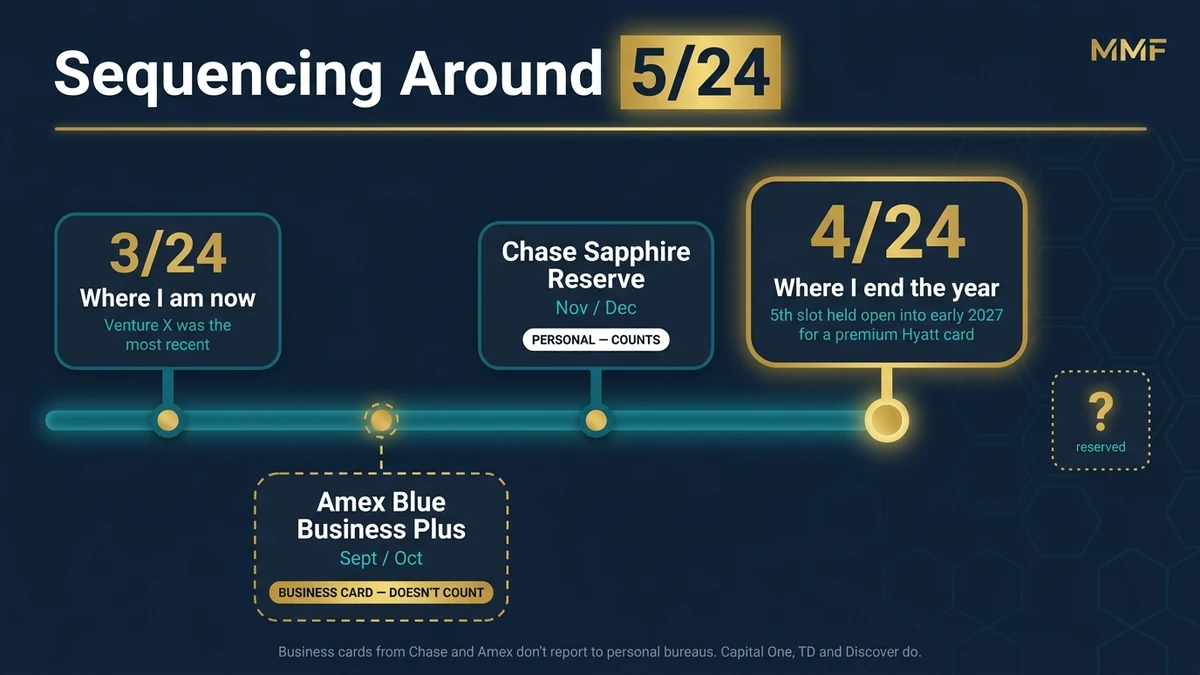
Want Chase cards at any point in the next two years? Then the Chase 5/24 rule decides your card count for you. Open five or more personal cards across all issuers in 24 months and Chase stops approving you, more or less regardless of your score or income.
So the limit isn’t a wellness question about how many cards a person can responsibly handle. It’s an arithmetic constraint, and you plan around it.
As of this writing I’m at 3/24, with the Venture X being the most recent one. One more personal card this year, the Sapphire Reserve, puts me at 4/24. I’m leaving that fifth slot open into early 2027 in case a premium Hyatt card shows up.
Now here’s the workaround people miss. Chase and Amex business cards generally don’t report to your personal credit bureaus, so they don’t add to your 5/24 count. That’s exactly why the Ink Business Preferred and the Blue Business Plus sit in my plan where they do. They let me keep earning bonuses without spending the slots I need for personal cards.
Two caveats before you go apply for six business cards. First, Chase still checks your 5/24 status when you apply for one of theirs, so a business card gets you around the counter but not around the gate. Second, this isn’t universal across issuers: Capital One, TD, and Discover business cards do report to your personal credit, so those count against you like any personal card.
Capital One Venture vs Venture X
Most people I work with find $300–$800/year in missed rewards from one wrong card or one misassigned category. I map your real spending and build a custom plan in a 30-minute call.
Not financial advice. Results vary by individual spend.
Since this comes up constantly, let’s be real. The Venture X is probably the better Venture card in Capital One’s lineup. Only problem for me was Capital One denied me through the preapproval tool for the better part of a year, so I took the Venture Rewards instead and ran its bonus. After all, the plus here is that getting the Venture bonus first allows you to get the Venture X bonus down the line. The reverse isn’t true however.
And of course, right as I’d given up on it, the preapproval finally hit for me. And quick update just got approved for the card!
On multipliers alone the Venture X is redundant with what I already carry, so I didn’t pick it up for the earn rate. I got it for two things: the welcome bonus and the Capital One Lounge access. Living in NYC with JFK and LGA as my home airports, the lounge math is a no-brainer for how I travel.
Capital One isn’t winning everything here though. Their transfer partners leave a little to be desired on the hotel side compared to what Chase gets you with Hyatt or what Amex gets you with Hilton and Marriott. If hotels are your redemption plan, that’s a good reason to build somewhere else. I broke the premium catch-all question down further in Bilt Palladium vs Venture X.
My plan for the Capital One miles is flights, likely somewhere in Asia in late 2027 or early 2028.
What I’m Adding for the Rest of 2026
I’ve been in between welcome bonuses for a bit waiting on a property loan to be finalized, but now that that’s done it’s time to start picking the pace back up.
Over the next three to six months I’ve got a decent amount of natural spending coming: furnishing a new place, a few trips, some larger one-off expenses. That should cover another one or two welcome offers easy.
The plan, in order:
- Venture X, for the bonus and the lounge access, before Capital One locks me out for the foreseeable future. Update just got approved a few weeks ago and am almost done with the sub!
- Amex Blue Business Plus around September or October. It’s a business card, so it spaces out my personal applications, and it gives my Rakuten payouts a better home. Rakuten’s intro rate into Bilt has ended for Blue members, who now get 50 Bilt points per dollar of cash back instead of 100. Silver and above kept the full rate. I caught the 1:1 window on about 66,000 points before it closed, which I’m still glad about.
- Chase Sapphire Reserve in November or early December, to double up on the credits before the new year and hopefully catch an elevated offer.
Heading into 2027 I’d start reorganizing what I already hold. The Sapphire Preferred gets downgraded to an OG Freedom when the annual fee hits in March. After that I’m looking hard at the Bilt Palladium, mostly because it could make my roughly $285 of core annual fees redundant in one move.
Who Should Run More Cards
I opened three new cards in the first half of this year and I’d do it again. That pace only works if every balance gets paid in full though. If you end up paying a dime of interest the points just aren’t worth it.
Best for:
- People who already pay in full every month, every month, without thinking about it
- Anyone with predictable natural spending coming up, like a move, a renovation, or a wedding
- Points optimizers who’ll use transfer partners instead of cashing out at a penny
- Anyone under 5/24 who wants Chase cards at some point and needs to sequence the slots
Not for:
- Anyone carrying a balance. Interest wipes out every bonus in this post, so pay that off first
- People early in their credit history, where a couple of well-managed cards do more than five. If that’s you, start with the beginner’s guide to building credit instead
- Anyone who’d need to manufacture spending to hit the minimums
- People who genuinely won’t track annual fees and credits, because unused credits are worth zero
How Many Credit Cards Should You Have FAQs
Does having multiple credit cards hurt your credit score?
Not on its own. More cards raise your total available credit, which usually lowers your utilization and helps. What hurts is the hard inquiry on each application and the drop in your average account age, and both of those recover. If you’re rebuilding, these strategies matter far more than your card count.
How many credit cards is too many?
Too many is one more than you can pay in full and keep track of, and there’s no universal number. Practically speaking, if you’re forgetting annual fees or missing due dates, you crossed the line already.
Is it bad to have credit cards you don’t use?
No, and closing them can hurt more than keeping them, since it drops your available credit and eventually your average age. Put one small recurring charge on each so the issuer doesn’t close it for inactivity. I rotate small subscriptions across my secondary cards for exactly this.
Should you open a card just for the welcome bonus?
That’s most of where the value is, so yes, with two conditions. You can hit the minimum spend on things you were buying anyway. And you’ve got a plan for when the annual fee comes due: downgrade it, cancel it, or keep it because it earns its fee.
How many cards should you have to build credit?
One or two, used lightly and paid in full. Card count isn’t what builds a score. Payment history and low utilization are, and those work the same whether you hold one card or ten.
Stop asking how many credit cards you should have and start asking what jobs your spending creates. Mine creates four. That four-card setup earned almost none of my $8,100 this year, and that’s the whole point. Coverage is a solved problem. The money lives in welcome bonuses, bank bonuses, and portals, so get your coverage clean and let your 5/24 count and your natural spending set the pace. If you want to go deeper on any single card here, the full Credit Card Reviews library has every angle I’ve covered.
What does your setup look like right now, and how many cards are actually pulling their weight? Drop it in the comments.

Capital One Venture Rewards
2x miles on everything, 5x hotels/rentals via C1 Travel. 75,000 bonus miles after $4,000 in 3 months. Up to $120 Global Entry/TSA PreCheck credit.
$95/yr
Capital One Savor Rewards
3% dining, entertainment, grocery, streaming. 8% via C1 Entertainment. No annual fee.
$0/yr
Chase Ink Business Preferred
3x on travel, shipping, ads, internet/phone (up to $150K/yr). Primary CDW. UR transfers.
$95/yr
Chase Sapphire Preferred
Best mid-tier travel card for beginners. Transfer to Hyatt, United, Southwest.
$95/yr
Capital One Venture X
10x hotels/rentals via C1 Travel, 5x flights via C1 Travel, 2x everything else. $300 travel credit, 10K anniversary miles, Priority Pass.
$395/yrChase Sapphire Reserve
$300 travel credit, Priority Pass, Global Entry/TSA Pre. Transfer to Hyatt, United, Southwest.
$795/yr
Amex Blue Business Plus
Flat 2x MR on everything up to $50K/yr, then 1x. No annual fee. Expanded buying power.
$0/yr
Bilt Palladium
2x everyday, 4% Bilt Cash flexible. $400/yr hotel credit, $200 Bilt Cash, Priority Pass. Up to 1.25x housing.
$495/yrTerms apply. Some links are affiliate links. I only recommend products I personally use or genuinely believe will help you. Pay your balance in full.
Some links are affiliate links. I only recommend products I personally use or genuinely believe will help you. Terms apply. Pay your balance in full. Applying results in a hard inquiry. Bank account bonuses are typically taxable income (1099-INT), so review all requirements before chasing one. I’m not a financial advisor or CPA. This is personal experience and opinion.
Join the discussion
Prompt
What's your experience with this card or strategy? Share your numbers.
Be the first to share your numbers
Real datapoints from the comments make this thread more useful than another review post.
Leave a comment