

Amex Gold vs Capital One Savor: Is the Gold Worth the Fee?
How much did you actually spend on food last month? Not just groceries. The coffee runs, the date nights, the DoorDash, that $14 smoothie you knew was a ripoff and ordered anyway. For most people food is one of the biggest line items in their budget, which is exactly why the card you use for it matters so much. Which brings up the real question: is the Amex Gold worth it for food spend, or does the no-fee Savor win?
The two heavy hitters for food spend are the American Express Gold and the Capital One Savor. On paper it looks like a blowout: the Gold earns 4x, the Savor earns 3%. So the Gold wins, right? Not so fast. This whole thing is really a break-even question, and the break-even sits a lot higher than most people think. Below a certain amount, the Savor’s $0 annual fee quietly beats the Gold’s $325 fee even though the Gold earns more per dollar. So the real answer isn’t “which card earns more.” It’s “how much do you spend on food, will you use the Gold’s credits, and are you redeeming for cash or transfer partners.” Let’s put both cards on the table and settle it once and for all.
Key Takeaways:
- The Amex Gold earns 4x on dining and 4x at U.S. supermarkets (up to $25,000 a year) but carries a $325 annual fee, while the Capital One Savor earns a flat 3% on dining, groceries, entertainment, and streaming for $0 a year.
- Redeeming Membership Rewards through transfer partners at about 1.8 cents each, the Gold’s 4x on food works out to roughly 7.2% back. The Savor sits at 3% cash, or about 3.7% if you convert to Capital One miles.
- With zero credits used, the Gold doesn’t beat the Savor until around $645 a month in food spend (cash) or $775 a month (miles). Use about $160 of the credits and that break-even drops to roughly $325 to $390 a month.
- Most people spend below that break-even, so for them the Savor is the better card. The Gold only pulls ahead for high food spenders who use the credits and play transfer partners.
| American Express Gold Card | Capital One Savor Rewards | |
|---|---|---|
| Annual fee | $325/yr | $0/yr |
| Top earn rates | Dining 4x · US Supermarkets 4x · Flights 3x | C1 Entertainment 8% · C1 Travel 5% · Dining 3% |
| Top partners | Delta · ANA · Hilton See all → | Turkish Airlines · Air Canada · Virgin Red See all → |
| Card network | American Express | Mastercard World Elite |
| Foreign tx fee | 0% | 0% |
| Best for | High food spenders, roughly $650 or more a month, who use the monthly credits and redeem Membership Rewards through transfer partners | Anyone who wants a flat 3% on food with no annual fee and nothing to track or remember |
| Not for | Anyone spending under about $325 a month on food, or who won't use the monthly credits | Travel optimizers who want transfer partners and premium redemptions from one single card |
| Apply Now → | Apply Now → |
Annual fee
Top earn rates
Top partners
Card network
Foreign tx fee
Best for
Not for
AMERICAN EXPRESS GOLD CARD
Apply Now →CAPITAL ONE SAVOR REWARDS
Apply Now →Terms apply. Some links are affiliate links. Credit card comparisons assume you pay your balance in full every month. Offers shown reflect what was current at publication date.
Why your food card matters more than you think
Want to run this math on your spending? Plug in your real numbers and see what each card actually earns you.
Free Calculator →Most people look at these two cards and think it’s straightforward. One has bigger multipliers, the other has no annual fee, pick your lane. But there’s a piece almost everyone skips, and once you see it the whole conversation shifts.
You’ve basically got two types of people who earn rewards on food. There’s the person who wants everything on autopilot: one card, no thinking, steady rewards that show up without any effort. And then there’s the person chasing the highest possible return, even if it means juggling credits or learning redemption strategies to get there. Neither one is wrong. But they lead to completely different answers. If you match the wrong card to how you really live, you pay for perks you never touch. Or you leave rewards on the table every single month.
I’ve watched people grab the Amex Gold because they heard it was the best food card. Then they spend $200 a month on dining and barely open the app to use the credits. In that situation the math doesn’t work in their favor at all. Indeed, that’s exactly why the Gold is either a monster or a money pit. It all depends on who’s holding it. So before you pick, you need the real numbers on both.
If you want free tools to run the numbers on your own card setup, I built a toolkit for exactly this.
Grab the free Rewards & Returns Toolkit
Amex Gold: the rewards, the fee, the credits
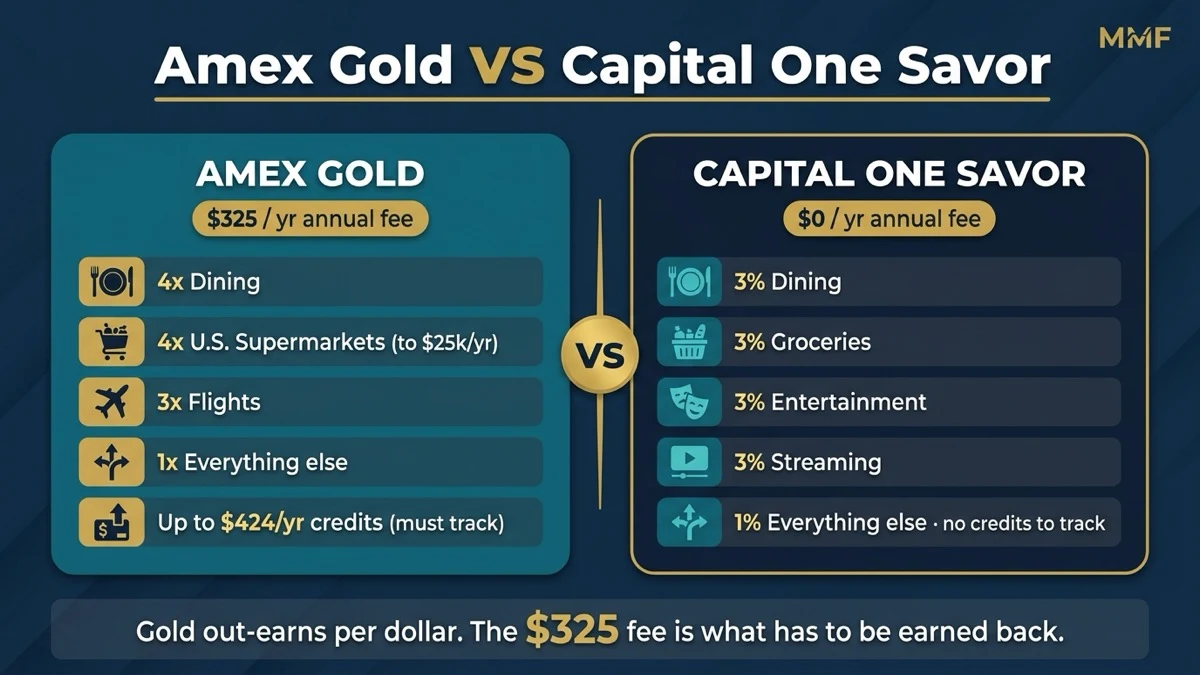
The Amex Gold is a card people either love or get completely overwhelmed by. Now it can be one of the best everyday cards out there. But only if you understand how to use it. If you don’t, that $325 annual fee starts to feel a lot heavier than it needs to.
Here’s what you’re earning. The Gold gets you 4x Membership Rewards points at restaurants worldwide, on up to $50,000 in dining per calendar year, then 1x after that. You also get 4x at U.S. supermarkets on up to $25,000 a year, then 1x, and both caps are spelled out on the official Amex Gold card page. On top of that it’s 3x on flights booked directly with the airline or through Amex Travel, and 5x on prepaid hotels through Amex Travel. Those food multipliers are some of the best in class, full stop.
What the Amex Gold annual fee costs you after credits
Then there’s the credit side of things, which is where the fee math lives. You get $10 a month in Uber Cash, which is $120 a year. There’s up to $10 a month in dining credits at Grubhub, Five Guys, Cheesecake Factory and a few others, another $120. Then up to $100 a year in Resy credits split into two halves, and up to $7 a month at Dunkin, or $84 a year. Add it all up and that’s $424 a year in potential credits sitting against a $325 fee. The Gold can also come with a welcome offer of up to 100,000 Membership Rewards points after $8,000 of spend in six months. That’s huge if you can hit it. Just know the offer is targeted, so you’ll only see your real number when you apply.
Where the Gold separates itself
Those multipliers get the attention, but the real edge is Membership Rewards points themselves. The value here is when you transfer to partners like Delta, Hilton, or Marriott. Doing this, good redemptions can land somewhere between 1.8 and 2.2 cents per point. At that kind of value, that 4x on food starts behaving like a 7% return instead of a 4% one. Now, that’s the ceiling, not the floor. If you just redeem Membership Rewards for cash at 1 cent, your 4x on dining is only worth about 4%. Then a $325 fee has to be justified on a much thinner margin. That gap is the whole reason the Gold rewards people who learn the system and punishes people who don’t.
Capital One Savor: simple 3% with no fee
Now let’s flip the approach completely, because the Savor takes the opposite path. This card is the definition of predictable. No drama, no juggling credits, no mental overhead.
You get 3% cash back on dining, groceries, entertainment, and popular streaming services, plus 1% on everything else, all for a $0 annual fee. Worth noting: the grocery 3% excludes superstores like Walmart and Target, so a Costco or Target run isn’t going to code as grocery. That exclusion is stated on Capital One’s own Savor page. It also runs 5% on hotels and rental cars booked through Capital One Travel and 8% through Capital One Entertainment, and there are no foreign transaction fees. Depending on your credit profile, new cardholders can currently grab a $250 cash bonus after spending $500 in the first three months.
I’ve had the Savor for about 1 year now. I product-changed my old Quicksilver into it, and I’ve genuinely been enjoying it. The two things I love are the dead-easy 3% on groceries and the entertainment and streaming multiplier. I put services like Peacock on it for the 3% back, and through the Capital One Entertainment portal I’ve pulled some crazy value. And I just bought Islanders tickets for my family and got 8% back on them, which is the kind of thing you don’t expect from a no-annual-fee card.
The Savor’s simple upgrade path
Here’s the part that makes the Savor more than a beginner card. That 3% is cash back by default. But hold a Capital One Venture or Venture X too, and you can move those rewards over. Then they turn into Capital One miles for transfer partners. So the Savor can be a standalone cash-back card, or it can be the everyday-spend engine in a Capital One duo. If you want the full breakdown on that two-card setup, I went deep on the Capital One ecosystem and why the boring version wins in its own post.
Strengths and weaknesses, head to head

Before we get to the math, here’s the honest scorecard on both. Because the break-even part makes a lot more sense once you see where each card wins and loses.
Which is the best credit card for groceries and dining?
| Amex Gold | Capital One Savor | |
|---|---|---|
| Annual fee | $325 | $0 |
| Dining | 4x points | 3% cash |
| Groceries | 4x (U.S. supermarkets, to $25k) | 3% (excludes superstores) |
| Entertainment / streaming | 1x | 3% cash |
| Credits | Up to $424/yr (must track) | None to track |
| Transfer partners | Yes (Delta, Hilton, Marriott) | Only if paired with a Venture card |
| Foreign transaction fee | $0 | $0 |
The Gold’s strengths are real. You get extremely strong earning on food, transferable points without needing a second card, and a pile of credits that can offset a big chunk of that fee. It’s built for high spenders, families, and anyone who wants to build out an Amex ecosystem. Where it struggles is the homework. You have to keep up with the credits, and there’s a learning curve on transfer partners. Amex also still gets declined in plenty of places internationally and at small shops, so you’ll probably want a backup card in your pocket.
The Savor’s strength is the opposite. Zero annual fee, three straightforward categories, no credits to track, and it works as a beginner-friendly setup you can basically forget about. But let’s name the specific thing the Gold has that the Savor doesn’t. As a standalone card there’s no real travel upside and no credit stack padding the value. Also no premium transfer partners like Delta or Hilton. The perks are thinner because the card is simpler. That’s the trade.
The break-even math
Most people I work with find $300–$800/year in missed rewards from one wrong card or one misassigned category. I map your real spending and build a custom plan in a 30-minute call.
Not financial advice. Results vary by individual spend.
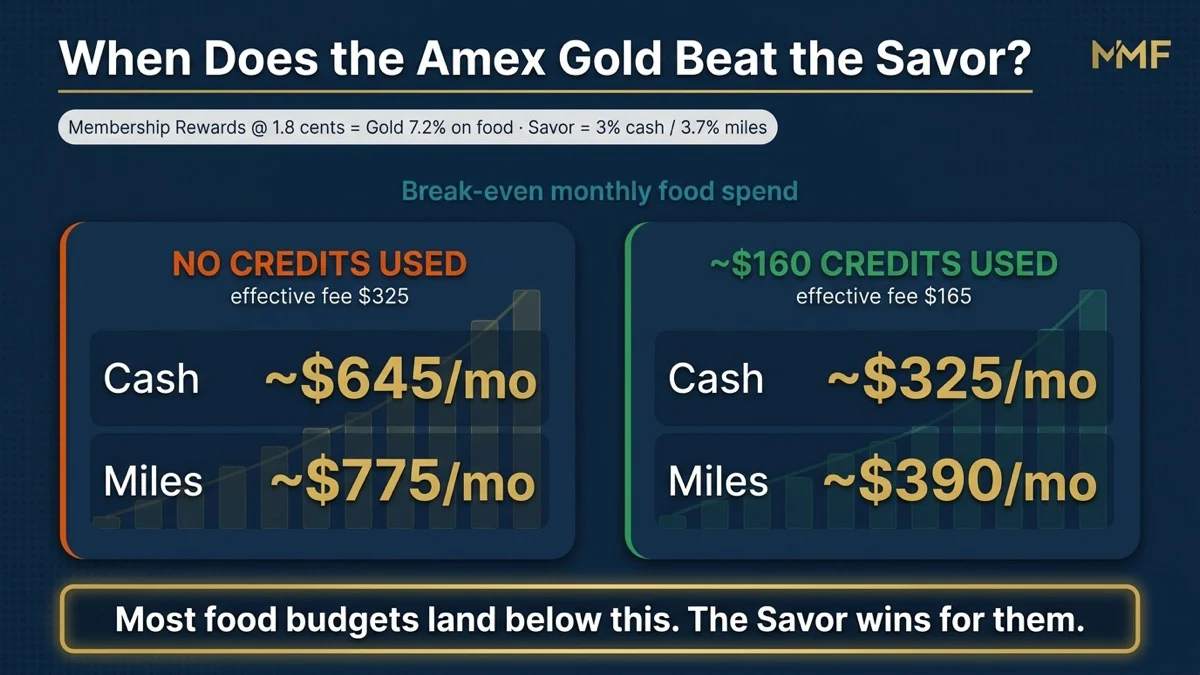
Alright, this is where it gets settled, so first the rules so we’re all on the same page. I’m going to value Membership Rewards at about 1.8 cents each through transfer partners, which is the conservative end of a good redemption. That puts the Gold’s 4x on food at roughly 7.2% back. The Savor earns a flat 3% as cash, or about 3.7% if you convert to Capital One miles and get around 1.2 cents of transfer value on them. And yeah, I know real life is messier than a clean percentage, but we need a baseline.
So the Gold’s edge over the Savor on food is about 4.2 points against Savor cash (7.2 minus 3). By comparison, it’s about 3.5 points against Savor miles (7.2 minus 3.7). The break-even is just your effective annual fee divided by that edge. And “effective” is doing the heavy lifting, because the fee you end up paying is $325 minus whatever credits you use.
No credits used, so the effective fee is the full $325. Against Savor cash, $325 divided by 4.2% is about $7,740 a year, or roughly $645 a month in food spend before the Gold pulls ahead. By comparison, against Savor miles, $325 divided by 3.5% is about $9,290 a year, or roughly $775 a month. Now say you squeeze about $160 of real value out of the credits, roughly the Resy dinners plus part of your Uber Cash. The effective fee drops to about $165. That moves the break-even down to about $325 a month against cash, or about $390 a month against miles.
Where the break-even lands for most people
So the honest range is this. The Gold doesn’t beat the Savor until somewhere between $325 and $775 a month in food spend. Specifically, that depends on how many credits you use and how you redeem. That’s a wide spread, and it’s the whole ballgame. If you barely touch the credits and take cash, you need to be spending close to $650 a month on food before the Gold makes sense. But if you max the credits and play transfer partners, that number drops to the low $300s. And most of us land below our own break-even. That’s not a knock, it’s just where normal food spending sits.
That break-even assumes a specific redemption value and a specific chunk of credits used. Yours will move based on how you eat, travel, and redeem. Most people I work with are leaving $300 to $800 a year on the table because their cards don’t match their real spend. If you want me to look at yours directly, book a Spend Audit ($97) and I’ll map the right setup to your numbers.
So is the Amex Gold worth it?

Here’s my honest read after running it. The math makes up about 75% of this decision. Overall, the other 25% is your goals and how much effort you want to spend managing a card. So let me split it cleanly.
The Gold is worth it if you spend somewhere north of $350 a month on food. Also if you’ll use at least half the credits without forcing it. And if you value Amex transfer partners and want a long-term Membership Rewards strategy. In that lane it’s a monster and the fee basically disappears. But if any of those legs are shaky, the fee starts eating your rewards.
I’d point you to the Savor if you want easy cash back with no annual fee. Same answer if you’re newer to this and don’t want to babysit a credit calendar. Or if a Capital One duo with the Venture X is the plan down the road. That’s the card I personally run for food, and 1 year in I haven’t once wished I were tracking a Dunkin credit instead. If your food spend lands under about $325 a month, the Savor is the better card for you, no real debate.
Best for / Not for
Amex Gold is best for:
- High food spenders, roughly $650 a month or more if you’re not leaning on the credits
- People who will reliably use the monthly Uber, dining, Resy, and Dunkin credits
- Anyone who values Membership Rewards transfer partners and wants a long-term Amex setup
- Families running heavy grocery and restaurant spend through one card
Amex Gold is not for:
- Anyone spending under about $325 a month on food
- People who won’t reliably use the credits or track them
- Anyone who only redeems points for cash at 1 cent
- Anyone carrying a credit card balance. Pay that off first before chasing rewards.
Capital One Savor is best for:
- Anyone who wants a flat 3% on food with zero annual fee and nothing to track
- Beginners building their first real rewards setup
- Streaming and entertainment spenders, thanks to the 3% and the 8% Capital One Entertainment rate
- Anyone planning a Capital One duo with the Venture or Venture X later
Capital One Savor is not for:
- Travel optimizers who want transfer partners and premium redemptions from a single card
- Heavy superstore grocery shoppers, since Walmart and Target don’t code as grocery
- Anyone who wants top-end multipliers and will do the work to earn them
Amex Gold vs Capital One Savor FAQs

Is the Amex Gold worth the $325 annual fee?
It’s worth it if you spend enough on food and use the credits. With no credits used, the Gold doesn’t beat a no-fee 3% card like the Savor until roughly $645 a month in food spend on cash redemptions. Use about $160 of the credits and that break-even drops to around $325 a month. Below that, a $0 card wins.
Does the Capital One Savor have an annual fee?
No. The Savor has a $0 annual fee and no foreign transaction fees, and it still earns 3% on dining, groceries, entertainment, and streaming. That’s the entire reason it competes with a $325 card in the first place.
Is the Amex Gold or Savor better for groceries?
On rate, the Gold wins at 4x versus 3%, but only at U.S. supermarkets and only on the first $25,000 a year. Neither card counts superstores like Walmart or Target as grocery. If you redeem Membership Rewards through transfer partners the Gold’s grocery earning is stronger. But if you take cash and don’t want a fee, the Savor’s 3% is the cleaner win.
Can you have both the Amex Gold and the Capital One Savor?
Yes, and some people do run both, using the Gold for dining and supermarkets and the Savor for entertainment and streaming where the Gold only earns 1x. Just make sure the Gold’s fee still pencils out once you split your food spend across two cards, because dividing the spend raises the Gold’s break-even.
How much do you need to spend for the Amex Gold to beat the Savor?
Somewhere between about $325 and $775 a month on food, depending on how many of the Gold’s credits you use and whether you redeem for cash or transfer-partner miles. Max the credits and play transfer partners and it’s the low end. Ignore the credits and take cash and it’s the high end.
If you want to see how these two stack up against the rest of the field, the full Credit Card Reviews library runs through every card I’ve broken down.
Amex Gold vs Capital One Savor comes down to one honest question: how much do you spend on food, and will you use the credits? The Gold out-earns the Savor per dollar. But the $325 fee means it doesn’t actually win until you’re spending $325 to $775 a month. And only if you use the credits and redeem well. The typical food budget lands below that, which is why the no-fee Savor is the better default for most people. So the Gold is the high-spender’s optimizer play. The Savor is the one I run for food, and for most of you it’s the smarter start.

American Express Gold Card
4x dining and US supermarkets. $10/mo Uber Cash, $10/mo dining credit, $7/mo Dunkin', $100 Resy credit/yr.
$325/yr
Capital One Savor Rewards
3% dining, entertainment, grocery, streaming. 8% via C1 Entertainment. No annual fee.
$0/yrTerms apply. Some links are affiliate links. I only recommend products I personally use or genuinely believe will help you. Pay your balance in full.
Some links are affiliate links. I only recommend products I personally use or genuinely believe will help you. Terms apply. Pay your balance in full. Applying results in a hard inquiry. I’m not a financial advisor or CPA. This is personal experience and opinion.
Join the discussion
Prompt
What's your experience with this card or strategy? Share your numbers.
Be the first to share your numbers
Real datapoints from the comments make this thread more useful than another review post.
Leave a comment