

Capital One vs Chase: Why the Boring Ecosystem Wins in 2026
Capital One has a reputation for being the boring issuer, the basic choice, and in the Capital One vs Chase debate most people will tell you Chase and Amex are just flat out better. I want to pump the brakes on that.
For a regular card user, the person who doesn’t want to babysit a spreadsheet full of credits every month, the Capital One ecosystem gives you about 90% of the points-and-miles value for almost none of the work. And in 2026, that simplicity is worth more than a higher ceiling most people never actually reach. Over the last year, Chase and Amex buried the value of their premium cards under a pile of coupons and quietly cut their base portal rates.
This isn’t a beginners-only argument either. If you’re an expert points and miles optimizer who’s just sick of managing the coupon book, Capital One might be one of the cleanest setups you can run right now too. Below I’m breaking down five of the best features of the Capital One ecosystem and why it’s quietly establishing itself as a top player among the giants like Amex and Chase.
Key Takeaways:
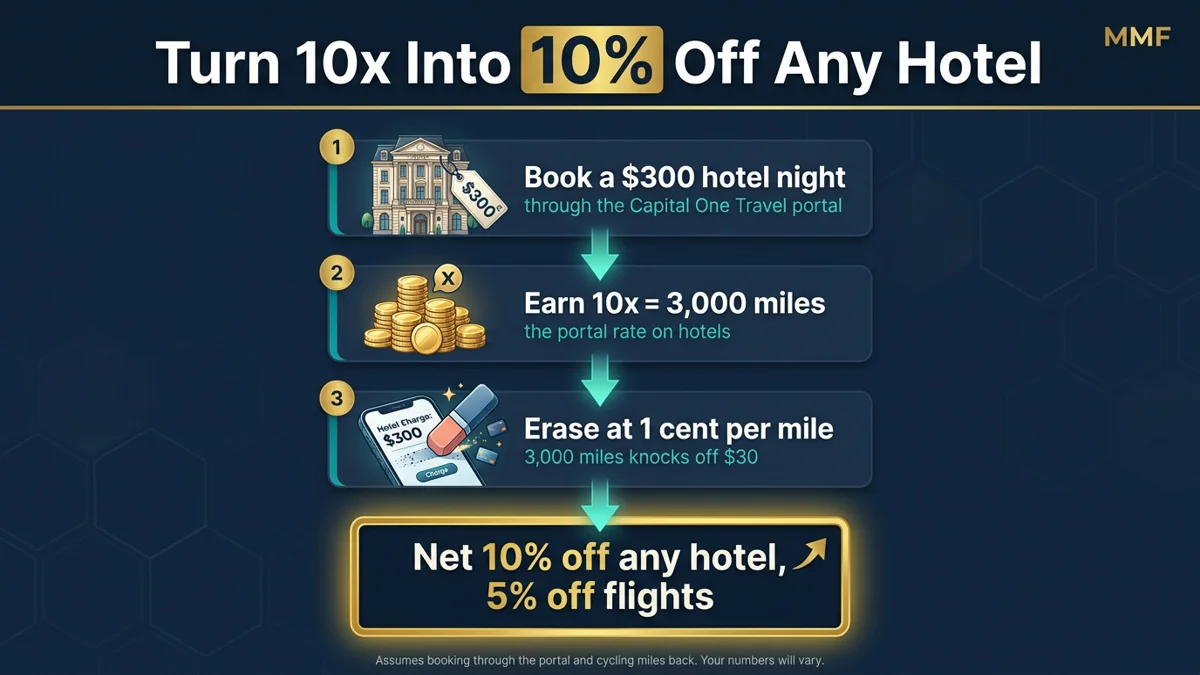
- The Capital One travel eraser gives you a flat 1 cent per mile against any travel charge, which turns the portal’s 10x hotels and 5x flights into roughly 10% off hotels and 5% off flights.
- Chase’s Points Boost reset the base portal rate to 1 cent for every card, the same floor as Capital One, but only some hand-picked listings get the boost.
- Amex pushed the Platinum to an $895 annual fee and Chase took the Sapphire Reserve to $795, both stacked with monthly and semi-annual credits you have to remember to use.
- You only need two cards, the Venture X and the Savor, to earn 2x to 10x on basically everything, with transfer partners still there when you want them.
- The couponification problem
- Feature 1: The travel eraser
- Feature 2: Capital One Offers
- Feature 3: Price match and price drop protection
- Feature 4: Activities you can redeem miles on
- Feature 5: You only need two cards
- Venture X vs Sapphire Reserve
- Where Capital One loses
- Two honorable mentions
- Best for / Not for
- Capital One vs Chase FAQs
| Capital One Venture X | Chase Sapphire Reserve | |
|---|---|---|
| Annual fee | $395/yr | $795/yr |
| Top earn rates | C1 Travel Hotels 10x · C1 Travel Flights 5x | Chase Travel Portal 10x · Dining 3x · Travel 3x |
| Top partners | Turkish Airlines · Air Canada · Virgin Red See all → | Hyatt · United · Southwest See all → |
| Card network | Visa Infinite | Visa Infinite |
| Foreign tx fee | 0% | 0% |
| Best for | Most people who want a flat 1-cent floor and a $300 credit that covers any travel, no coupon book | Hobbyists who will use every credit and chase every boosted Points Boost redemption for the higher ceiling |
| Not for | Anyone chasing the absolute highest ceiling who enjoys optimizing as a hobby | Anyone who won't track and actually use $795 in scattered credits |
| Apply Now → | Apply Now → |
Annual fee
Top earn rates
Top partners
Card network
Foreign tx fee
Best for
Not for
CAPITAL ONE VENTURE X
Apply Now →CHASE SAPPHIRE RESERVE
Apply Now →Terms apply. Some links are affiliate links. Credit card comparisons assume you pay your balance in full every month. Offers shown reflect what was current at publication date.
Why this matters now more than ever
Want to run this math on your spending? Plug in your real numbers and see what each card actually earns you.
Free Calculator →Think about what happened over the last year. The couponification of credit cards hit an all-time high. Amex pushed its Platinum annual fee all the way up to $895. Chase did the same thing with the Sapphire Reserve, taking it to $795. And both of them buried that value across a slew of credits, ranging from monthly to semi-annual to yearly.
Now, to be fair, if you actually use those credits and the tracking doesn’t bother you, you can pull a ton of value out of those cards. I’m not going to pretend they’re bad cards. But Capital One took a different path. Aside from the Venture X change in lounge access, the value proposition and cards stayed mostly the same. And in today’s points and miles landscape I think that’s a real differentiator.
Here’s the part that pushed this from a preference to a math argument. Chase used to give you an elevated flat rate through its portal, 1.5 cents for the Reserve and 1.25 for the Preferred. Then the new Points Boost feature killed those flat rates. Now the base floor is 1 cent per point for every Chase card on any listing that isn’t hand-picked for a boost. That’s a 33% cut for the Reserve and a 20% cut for the Preferred on everything else. So Chase’s baseline redemption is now the exact same 1 cent as Capital One’s eraser. Except Capital One’s version works on everything and Chase’s better rate is conditional.
If you want free tools to run the numbers on your own card setup, I built a toolkit for exactly this.
Grab the free Rewards & Returns Toolkit
Feature 1: The travel eraser
This is honestly the main reason I keep recommending the Venture X and the Capital One ecosystem in general to beginners. For those who just want solid value without a second job, it’s hard to beat. The first feature that demonstrates this is the travel eraser, which Capital One recently renamed to “cover travel purchases” in the app. Same mechanics, just a new label.
Here’s the thing about points nobody tells you when you start. Earning points is easy. Getting decent value for them is the annoying part. Normally you save up a stash of miles and go to book your flight. Then either there’s no award availability, the point cost is insane, or the only halfway-decent deal is on some airline you don’t want to fly. So most people just pay cash and let their points rot. Or they redeem for garbage value and feel bad about it.
The eraser fixes that. You book whatever travel you want on any site, an airline, a hotel, anywhere. Then you go into the app and erase the charge with your miles at a flat 1 cent per mile. You’ve got 90 days from when the charge posts to do it.
The portal stack that makes it worth it
Now, here’s where it actually gets powerful. Book through the Capital One Travel portal instead. Say you book a hotel for $300 a night through the portal. On the Venture X that earns 10x, so 3,000 miles. Then you turn around and erase part of that cost with those miles. That’s $30 knocked off at 1 cent each.
So what does that actually come out to? A fixed 10% off any hotel and 5% off any flight booked through the portal, just from cycling the earned miles back against the cost. Stack that with the $300 annual travel credit the Venture X gives you and it compounds. That’s basically what my family did in Portugal to get around $600 off a suite on the Algarve coast.
And that’s the part I like. You don’t have to be a points expert to get real value out of your miles. For the optimizers, it raises the floor on what your points are worth. And for everyone else, you just book with your card, earn, and save. Amex has nothing like this fixed-redemption style. Instead, you pretty much have to learn transfer partners to get decent value out of Membership Rewards.
Feature 2: Capital One Offers
This next feature might actually be my favorite, because it’s basically free money almost nobody talks about. It’s also the one I use every single week.
Log into your Capital One account and there’s a section called Capital One Offers. It’s a list of deals from specific stores, both in-person and online. You tap to activate the one you want. Then you either shop through the link or pay in person with your Capital One card, and you get bonus miles or cash back on top of whatever your card already earns.
And the spend needed to trigger them is low. On my Venture Rewards card I regularly see offers like spend $20, get 1,000 to 1,500 miles at places I’m already going, like Panera, Five Guys or CVS. Usually there’s one or two good ones a day.
Let me break down what that’s actually worth. Let’s say you spend $20 and you get 1,000 miles. At 1 cent a mile, that’s $10 back on a $20 purchase. On that single transaction, that’s a 50% return! Look, is an extra 1,000 miles going to make or break your next redemption? Probably not. But think about what it’s really giving you over a year.
Say twice a month you activate an offer and grab lunch or pick up some stuff at CVS, things you were buying anyway. Over 12 months that’s around $480 of spending you had planned regardless. And you pull roughly 24,000 miles back on it. That’s about $240 in travel for essentially no extra spend. It’s one more shopping portal to throw into the mix, and it takes about 10 seconds to activate. No codes, no coupons, just a phone tap.
Feature 3: Price match and price drop protection
Here’s a situation everyone’s been in. You book a flight or a hotel and you feel good about it. Then a few days later the price drops and now you’re annoyed you left money on the table. Or you do the opposite, sit around trying to time it perfectly, and the price goes up instead. Booking travel turns into a guessing game where you lose either way.
Capital One built the answer into the portal, and it’s a two-part system. First is the Best Price Guarantee. Book a trip through Capital One Travel, and if within 24 hours you find the exact same thing cheaper somewhere else, they credit you the difference as travel credit. Same flight or hotel, same dates. That matters because portal bookings often run a little pricier than booking direct, which is annoying when you’re trying to use up portal credits. So the price match puts portal bookings on a level playing field with every other travel site. I just used this on a hotel I’ve got coming up in Philly and it saved me around $30 for the night.
Quick pro tip: wait as long as you can inside that 24-hour window before you check. Prices often spike right after you book because of dynamic pricing. Then they settle back down around 20 to 23 hours later, usually below what you paid. That’s when you pounce. The whole thing took me about two or three minutes over the phone.
Price Drop Protection watches the flight for you
Second is Price Drop Protection. When you book a flight and the portal tells you to go ahead and book, it keeps watching that flight for 10 days. If the price drops in that window, it automatically refunds you the difference, up to $50, and you don’t have to do anything. One note on both of these. They pay out as Capital One travel credits, not cash. The price match has to be an exact match on the public price, and the drop protection caps at $50 and only covers flights. But it’s all baked in for free. You’re not signing up for anything.
Feature 4: Activities you can actually redeem miles on
For the longest time, travel portals were only good at the main stuff, flights, hotels, car rentals. Once you got to your destination, the tours and excursions came out of pocket. In 2025 Capital One changed that. They added an Activities section to the portal, powered by Viator, with 150,000-plus things to do bookable right inside Capital One Travel.
Why this matters is that everything we’ve covered so far works in here too. Book an activity through the portal on the Venture X and you earn 5x miles. Then you can turn around and use the travel eraser on it, or apply your $300 travel credit or a price-match credit against it.
Now, some of you are thinking Chase basically has the same thing. On the surface, sure. But go back to the variables. On the Chase side those activities earn points, and when you redeem you’re stuck at a flat 1 cent. The Points Boost feature everyone talks about doesn’t even apply to activities. So there’s no special play there. Capital One’s portal is also fixed at 1 cent. But on top of that, you’ve got the eraser working and you can wipe out part of the cost with your credits. That’s something Chase can’t match right now.
Feature 5: The real edge is you only need two cards
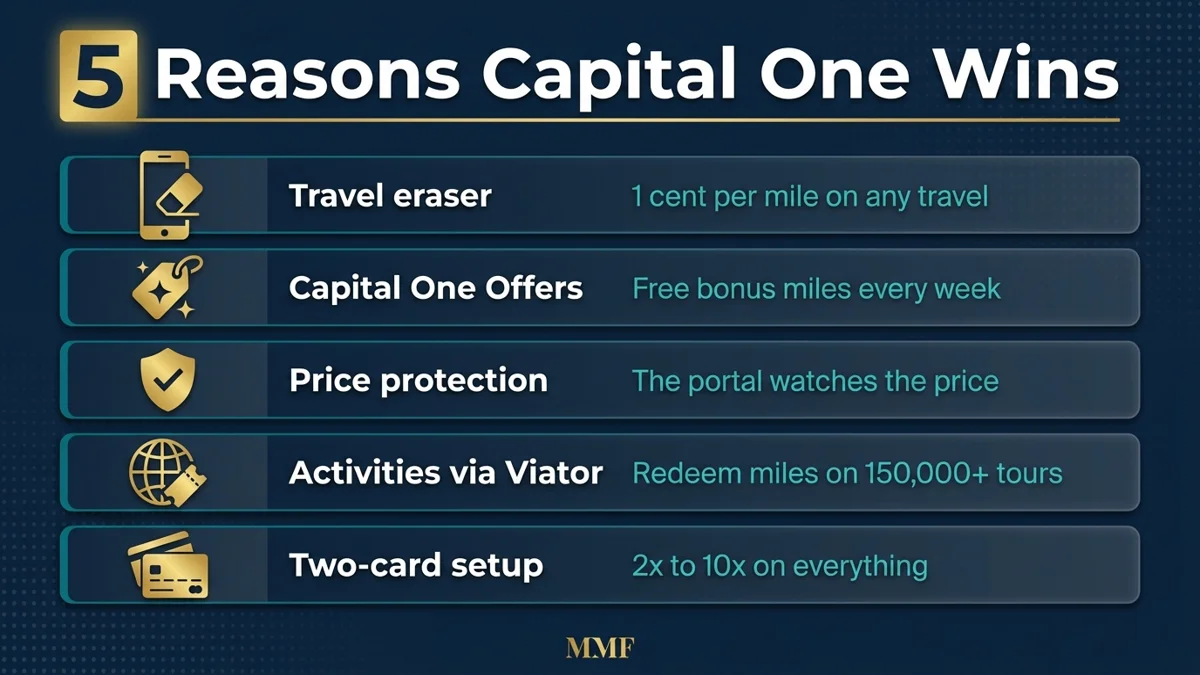
Number five is the most important one, and it’s not really a feature at all. It’s the whole philosophy. Capital One is just straight-up simple.
To get the most value out of everything in this post, you really only need one or two cards. For most people the play is the duo everyone loves: the Venture X and the Savor. The Savor is your no-annual-fee card that earns 3% on dining, groceries, entertainment, and streaming. Then the Venture X is your travel and catch-all card at 2x on everything, plus 10x on hotels and 5x on flights through the portal. So with two cards you’re earning anywhere from 2x to 10x on basically everything you buy.
The floor doesn’t cost you the ceiling
Here’s the part people miss. A solid baseline floor doesn’t mean you’re giving up the ceiling. The transfer partners are still there when you want them, around 22 of them, mostly 1:1, with a 1,000-mile minimum. So you can keep it dead simple for years, booking economy flights around the country at 1 cent of guaranteed value. Then once you’ve built up a stash, you still have transfer-partner access to book a crazy international business-class redemption or a big hotel stay.
That’s exactly why this is the number one ecosystem I recommend for someone who wants strong rewards but doesn’t want to turn it into a full-time hobby. No wasted cards. Every card has a job.
That 10% off hotels number assumes you book through the portal and actually cycle the miles back. Yours will look different depending on how you travel and what you spend. Most people I work with are leaving $300 to $800 a year on the table because their cards don’t match their real spend. If you want me to look at yours directly, book a Spend Audit ($97) and I’ll map the right setup to your numbers.
Venture X vs Sapphire Reserve: the head-to-head
Most people I work with find $300–$800/year in missed rewards from one wrong card or one misassigned category. I map your real spending and build a custom plan in a 30-minute call.
Not financial advice. Results vary by individual spend.

This is the Capital One vs Chase comparison everyone wants, so let’s put the two premium catch-alls side by side. The Venture X runs $395 a year with a $300 travel credit and 10,000 anniversary miles. That effectively drops the real cost close to nothing if you travel at all. By comparison, the Sapphire Reserve is $795 a year with a stack of credits you have to activate and remember across the year to get whole.
On redemption, the Reserve can beat the Venture X when Points Boost lands on a listing, up to 2x value. But on everything else, both cards now floor at the same 1 cent, and the Venture X gets there without you hunting for a boosted listing. On simplicity, it’s not close. The Venture X credit is one $300 travel credit that covers almost any travel charge through the portal. Meanwhile, the Reserve’s value is spread across multiple credits you have to track.
If you love the game and don’t mind tracking and using those Reserve credits, the Reserve undoubtedly has a higher ceiling. But for most people, the Venture X wins guaranteed value year in and year out. If you want a similar-style premium catch-all breakdown, I compared the Venture X against the Bilt Palladium in its own post.
Where Capital One loses
I’m not going to sell you a card that’s perfect, because it isn’t. Capital One made its own premium perks worse in 2026. As of February 1, authorized users now pay $125 a year for lounge access. Complimentary guests are gated behind $75,000 in annual spend, and Priority Pass guests cost $35 each on the consumer Venture X. So if lounge access for your whole family was the draw, that got materially worse. But if you’re a solo traveler, or you’re like me and the rest of your family already has a Venture X, you’re welcoming this change to put a stop to the overcrowded lounges.
And the ceiling argument when it comes to Chase and Amex is definitely real. If you’re willing to put in the work, Chase and Amex will always have higher top-end cards. Amex transfer partners and the Platinum’s luxury hotel benefits can beat anything Capital One offers if you optimize hard. Chase’s Points Boost, when it hits, is genuinely strong. And both programs have flagship domestic hotel and airline transfer partners like Hilton, Hyatt, United, and Delta that Capital One just can’t compete with. However, here’s the truth: Capital One isn’t trying to be the flashiest program out there, and it won’t be.
It’s not trying to lead the premium credit card market. Its strength is that simple beats fancy for most people, especially now that fancy costs $795 to $895 a year and comes with homework.
Two honorable mentions
Two more pieces of the Capital One world that aren’t tied to the credit cards directly.
First is Capital One Shopping. It’s a free browser extension, separate from Capital One Offers, and anyone can use it without a Capital One account. Instead of miles or cash back, you earn credits redeemable for gift cards, and I’ve pulled solid deals out of it.
Second is the Capital One 360 Checking account. It has no monthly fees, no minimums, direct deposit up to two days early, around 70,000 fee-free ATMs, and no foreign transaction fees on the debit card when you travel. Right now there’s a $300 bonus for setting up qualifying direct deposits. I originally opened it as a bank-bonus play and kept it because the seamlessness of the app ties both my banking and credit cards together so well.
Best for / Not for
Best for:
- Regular card users who want strong rewards without tracking a monthly coupon book
- Beginners who want guaranteed value from their miles on day one, not after learning transfer partners
- Optimizers who are done managing four premium annual fees and their credit calendars
- Anyone who travels enough to zero out a $300 travel credit but not enough to justify $795 to $895 in fees
Not for:
- Hardcore optimizers who will genuinely use every Amex and Chase credit and chase every boosted redemption
- People who want the absolute highest ceiling and enjoy the game as a hobby
- Anyone carrying a credit card balance. Pay that off before chasing any of this.
Capital One vs Chase FAQs
Is Capital One or Chase better in 2026?
For most people, Capital One is the better default. Its base redemption is a flat 1 cent per mile on any travel charge. That now matches Chase’s new floor while taking far less work. Chase can win at the top end when Points Boost lands or if you have a card that unlocks 1:1 Hyatt transfers. But you have to work for it.
Are Capital One miles worth as much as Chase points?
On guaranteed, no-effort redemptions they’re now equal, both floor at 1 cent. Chase points can be worth more through select transfer partners and boosted portal listings. But that value is conditional and takes effort. So Capital One’s floor is higher for the average person because it’s automatic.
Is the Venture X worth it?
If you travel enough to use the $300 annual travel credit, effectively yes, since the credit and 10,000 anniversary miles offset most of the $395 fee. The 2x-on-everything base plus 10x hotels and 5x flights through the portal makes it a strong catch-all. It fits people who don’t want to manage multiple premium cards.
Can you transfer Capital One miles to airlines?
Yes. Capital One has around 22 transfer partners, mostly at a 1:1 ratio with a 1,000-mile minimum. Partners include Air Canada Aeroplan, Avianca, Flying Blue, Turkish, Virgin, and British Airways. So the simple 1-cent floor doesn’t cost you the option to chase premium-cabin redemptions later.
What is the Capital One travel eraser?
It’s a redemption feature, now labeled “cover travel purchases.” You erase a travel charge with your miles at a flat 1 cent each within 90 days of the charge posting. Booked through the Capital One Travel portal, cycling earned miles back against the cost works out to roughly 10% off hotels and 5% off flights.
If you want to see how these cards stack up against everything else in the space, the full Travel & Points library runs through every card I’ve broken down.
The Capital One vs Chase math is straightforward: Chase and Amex will always have a higher ceiling if you’re willing to do the work. But in 2026 the work got more expensive and the base rewards got worse. Capital One quietly kept things simple: a flat 1-cent floor on every mile, free money sitting in your Offers tab, price protection baked into the portal, and a two-card setup that earns 2x to 10x on everything. For the person who wants real value without a second job, that’s the ecosystem I’d start with.

Capital One Venture X
10x hotels/rentals via C1 Travel, 5x flights via C1 Travel, 2x everything else. $300 travel credit, 10K anniversary miles, Priority Pass.
$395/yr
Capital One Savor Rewards
3% dining, entertainment, grocery, streaming. 8% via C1 Entertainment. No annual fee.
$0/yrTerms apply. Some links are affiliate links. I only recommend products I personally use or genuinely believe will help you. Pay your balance in full.
Some links are affiliate links. I only recommend products I personally use or genuinely believe will help you. Terms apply. Pay your balance in full. Applying results in a hard inquiry. Bank bonuses are typically taxable income (1099-INT). Review all requirements. I’m not a financial advisor or CPA. This is personal experience and opinion.
Join the discussion
Prompt
What's your experience with this card or strategy? Share your numbers.
Be the first to share your numbers
Real datapoints from the comments make this thread more useful than another review post.
Leave a comment