

Amex Green Card Benefits vs Chase Sapphire Preferred
Sixty dollars a year. That’s the entire fee gap separating the Amex Green Card from the Chase Sapphire Preferred, and it’s the main reason people dismiss the Green before running the numbers.
For the right person, those sixty dollars come back fast. The Amex Green Card benefits include uncapped 3X on all travel purchases, 3X on transit, and a credit structure that doesn’t require you to force a booking you didn’t want. If you live in a metro area and book travel outside Chase’s portal, this card is criminally underrated.
I’ve been carrying the Chase Sapphire Preferred as my main travel card for years. Running this comparison on my own spend is what convinced me the Green deserves a serious look.
Key Takeaways
- With the Amex Green, you earn 3X on all travel purchases vs. the CSP’s effective 2X when booking direct with airlines, Airbnbs, or third-party sites
- City dwellers spending $6,000/year each on travel and transit capture roughly $240 more in annual points value with the Green
- CLEAR Plus credit doesn’t force extra spending to use, unlike the CSP’s $50 hotel credit tied to Chase’s booking portal
- Amex MR integration with Rakuten creates a points-earning shopping category that the Chase ecosystem can’t match
In This Post
| American Express Green Card | Chase Sapphire Preferred | |
|---|---|---|
| Annual fee | Discontinued | $95/yr |
| Welcome bonus | 40K MR · $3K/6mo | 75K UR · $5K/3mo |
| Top earn rates | Travel 3x · Transit 3x · Dining 3x | Chase Travel Portal 5x · Dining 3x · Streaming 3x |
| Top partners | Delta · ANA · Hilton See all → | Hyatt · United · Southwest See all → |
| Card network | American Express | Visa Signature |
| Foreign tx fee | 0% | 0% |
| Best for | Metro commuters + direct bookers + CLEAR users | Chase Travel loyalists + max Visa coverage |
| Not for | Chase Travel loyalists | Metro commuters + CLEAR users |
| No Link | Apply Now → |
Annual fee
Welcome bonus
Top earn rates
Top partners
Card network
Foreign tx fee
Best for
Not for
AMERICAN EXPRESS GREEN CARD
No LinkCHASE SAPPHIRE PREFERRED
Apply Now →Terms apply. Some links are affiliate links. Credit card comparisons assume you pay your balance in full every month. Offers shown reflect what was current at publication date.
The Biggest Lie About the 5X Travel Rate
Want to run this math on your spending? Plug in your real numbers and see what each card actually earns you.
Free Calculator →Chase advertises 5X on travel, but that rate only applies when you book through Chase Travel.
I’ve been using the CSP as my main travel card for years, and the reality is I rarely touch the Chase portal. Direct airline bookings, Airbnb, Expedia when the rate is genuinely better: that’s how most people actually travel. Book anywhere outside Chase Travel, and the Sapphire Preferred drops to 2X on travel.
The Amex Green doesn’t play that game. It earns 3X on eligible travel purchases regardless of where you book. Direct with Delta, an Airbnb, a boutique hotel’s own website: all 3X, no portal required.
One extra point per dollar doesn’t sound revolutionary. But at $6,000 in annual travel spend, the numbers tell a different story:
- Amex Green: 18,000 MR points
- Chase Sapphire Preferred (booking direct): 12,000 UR points
At a 2-cent-per-point valuation, consistent with the most current TPG estimates for both MR and UR points: that’s $360 vs. $240, a $120 annual difference from travel alone.
That gap covers more than half the $55 fee difference between these two cards ($150 for the Green vs. $95 for the CSP). And we haven’t touched the category that actually breaks this comparison open.
If you want to run this math against your own monthly spend before going further, I built a free tool for exactly that:
Grab the free Rewards & Returns Toolkit

The Transit Category That Changes the Math
This is the section most card reviews skip, and for metro commuters, it matters more than the travel multiplier.
Living in New York, my commuting costs are real and not small. Monthly metro tickets, subway reloads, Ubers, the occasional toll driving into the city: I can easily spend $6,000 a year on transit alone. For people in Chicago, LA, or any dense metro, the number is similar or worse once you factor in parking and congestion pricing.
The Amex Green earns 3X on transit. Not “select transit.” Transit: rideshare, public transit, commuter rail, parking, tolls.
The Chase Sapphire Preferred has some transit coverage, but depending on the merchant code, a lot of real-world transit spend lands in the 2X bucket.
Run the same math on $6,000 in transit spend:
- Amex Green: 18,000 MR points, worth roughly $360 at 2 cents per point
- CSP: 12,000 UR points, worth roughly $240
Another $120 annual gap.
Add the travel and transit categories together: $240 more in annual points value from the Green, against a $55 fee premium. For someone spending meaningfully on both, the net advantage is roughly $185/year. For frequent travelers and commuters, the math here is clean. And we haven’t even touched the credits or the biggest upside play with this card: Rakuten.
I covered the full calculation live in the video above if you want to see it broken down step by step.
Free Credit Card Strategy Tools
Get the ROI Calculator, Points Toolkit, and more. I’ll send them straight to your inbox.
Credits You Will Actually Use
Fair warning: I’m going to be honest about the CSP hotel credit here, because I genuinely tried to make it work.
The Chase Sapphire Preferred includes a $50 annual hotel credit for bookings through Chase Travel which sounds good on paper. In practice, I’ve scrolled Chase Travel looking at $350 to $400 weekend stays I didn’t particularly want, just to burn that $50. That’s not saving money. That’s just spending it.
The credit has a structural problem. It requires a hotel booking through the Chase portal specifically, where prices are sometimes elevated. You’re often paying a premium to access the discount, which defeats the purpose.
The Amex Green’s statement credit toward CLEAR Plus is different (up to $209/year as of April 2026, terms apply). Is CLEAR worth the full retail price for everyone? No. If you fly once or twice a year from smaller airports, this credit won’t move the needle for you.
But here’s the honest test: if you fly regularly out of airports like JFK, LaGuardia, or Newark, CLEAR speeds you through security without changing how you book anything. Even if you only value CLEAR at twenty to seventy-five dollars in personal terms, you capture that value automatically. No extra hotel booking required.
I know what you’re thinking: both credits have conditions. Fair objection. The question is which credit you’ll actually use without distorting your normal travel behavior. For most city travelers, the CLEAR credit wins that test, and it’s not particularly close.
The Rakuten Factor
This is the detail that pushed me from “these cards are comparable” to “the Green has a real edge.”
Rakuten is a shopping portal that normally pays cash back on online purchases. But if you have an Amex Membership Rewards card, you can switch your Rakuten account to pay out in MR points instead of cash back.
That creates an entirely new earn category: online shopping, without changing anything you buy or where you buy it. At $150 per year, the Amex Green is one of the cheapest entry points into the MR ecosystem. Compare that to $895 for the Platinum or $325 for the Gold. You’re getting access to the same Rakuten point earning engine at a fraction of the cost.
Chase has no equivalent move. UR points are excellent for portal redemptions and hotel transfers, but there is no Chase version of the Rakuten integration. That feature is specific to Amex MR cardholders.
Membership Rewards points have serious depth on the transfer partner side too. If you want to see exactly where MR points can transfer and what the best redemption sweet spots are, Frequent Miler has a great comprehensive guide.
If you want to try Rakuten for yourself, sign up here. New members get a bonus just for signing up. Quick heads up: this is an affiliate link, so I would get some bonus points too at no cost to you.
Where the Sapphire Preferred Still Wins
Most people I work with find $300–$800/year in missed rewards from one wrong card or one misassigned category. I map your real spending and build a custom plan in a 30-minute call.
Not financial advice. Results vary by individual spend.
I want to be straight about this, because the CSP is still in my wallet and despite people hating on it lately, I still think it’s a solid entry level travel card.
The first thing I’d flag is acceptance. Amex still gets turned away at certain spots internationally and even some domestic merchants where Visa goes through without a second thought. If you travel somewhere off the beaten path or just don’t want to think about which card to pull out, the CSP wins that battle cleanly.
The other thing I genuinely respect about the CSP is the travel protection package. Trip delay coverage, baggage delay, primary rental car insurance: it’s a strong suite for a $95 card. I’ll be straight with you, when I sat down and compared the Green’s protections side by side with the CSP’s, it was closer than I expected. The CSP edges it out. That matters if you’re someone who actually files claims or wants the peace of mind on longer trips.
And the 10% anniversary bonus is a quiet win that a lot of people sleep on. Every year Chase drops 10% of whatever you spent back into your account as bonus UR points. On $30,000 in spend that’s 3,000 free points just for renewing. It’s not flashy but it adds up over time.
One Thing That Changed in 2025
One thing worth flagging: as of October 2025, Chase removed the guaranteed 1.25 cent floor when redeeming UR points through Chase Travel. You can still get boosted rates on specific redemptions through the portal, but there’s no longer a reliable baseline floor you can count on across the board. That makes transfer partners the more consistent path to strong value, and it makes the portal argument for the CSP a bit weaker than it was a year ago.
For someone who books primarily through Chase Travel, doesn’t have significant transit spend, wants maximum Visa coverage, and takes advantage of the 3X online grocery category, the CSP is genuinely the better card. That’s not a forced concession. It’s a real win for that person’s situation.
If you are deep in the Chase ecosystem and still trying to figure out if the Sapphire Preferred belongs in your stack, I cover why the Ink Preferred may be the better option in my Sapphire Preferred downgrade strategy. It breaks down the math on why the Ink Business Preferred can edge it out at that same $95 fee for travel-heavy spenders.
Who Should Get Which Card
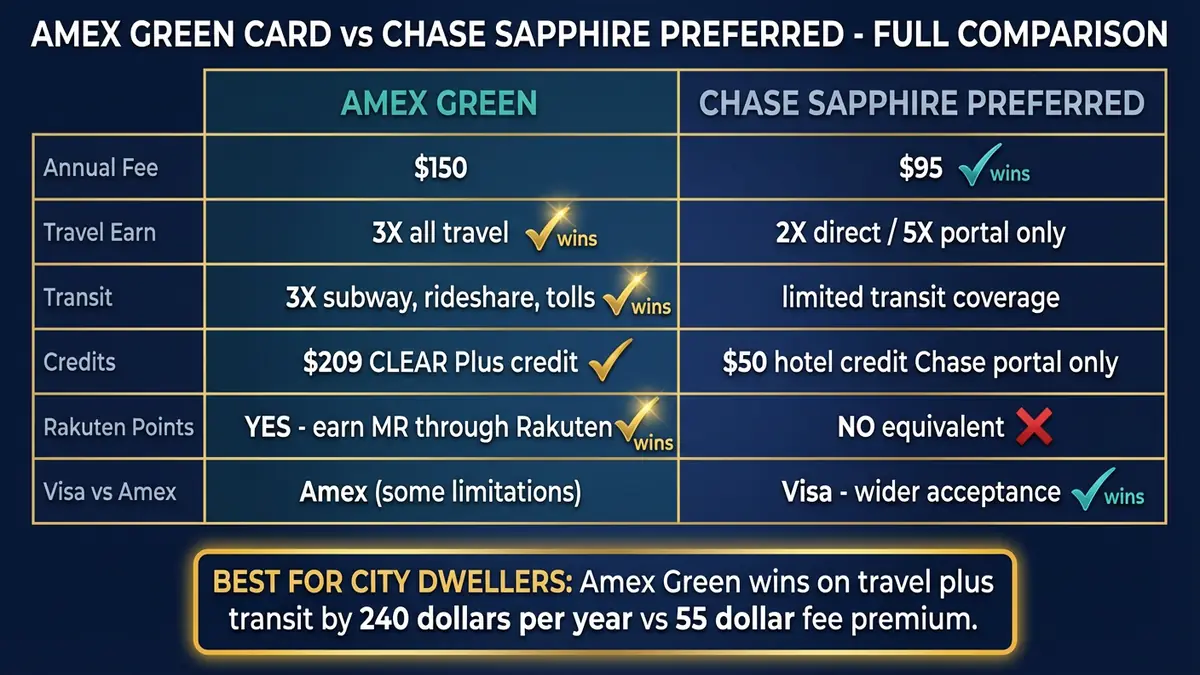
Who Should Get the Amex Green
If you live in a city with real commuting costs, book travel direct instead of through portals, and want into the Amex MR ecosystem without paying Platinum or Gold prices, the Green is the move. CLEAR Plus at airports like JFK or Newark adds real value if you fly regularly, and if you’re already using Rakuten for online shopping, switching to MR payouts is a no-brainer add-on at no extra cost.
Who Should Get the Chase Sapphire Preferred
If you’re someone who actually books hotels through Chase Travel and will use that $50 credit, or you travel internationally and want a card that works everywhere without thinking about it, stick with the CSP. The travel protections are genuinely strong for the price, and if you’re building out a Chase stack with Ink cards or Freedom cards, the CSP fits cleanly into that setup. The Bilt Obsidian + Sapphire Preferred duo is a good example of how the CSP anchors a high-returning two-card setup when it’s paired right.
Want someone to run these numbers against your actual monthly spend? I offer 1:1 Spend Audits where I map your spend categories, find the gaps, and build a custom card plan.
Are Amex Green Card Benefits Worth the Extra Fee?
The critics have been wrong about this card for a while now. Criminally so.
For a city dweller spending real money on travel outside portals and transit, the Amex Green generates $240 more in annual points value than the CSP, against a $55 fee premium. The math erases that premium before summer. Add a CLEAR Plus credit you’ll actually use and a Rakuten integration Chase simply can’t match, and there’s a legitimate case this is the better mid-tier travel card for 2026.
The CSP is still a solid card for someone who books through Chase Travel, lives outside a major metro, or wants maximum Visa coverage. If you’re still weighing mid-tier travel cards side by side, the Travel & Points archive covers every card in the lane. There’s no universal answer here. But if you’re someone who books direct and wants into the Amex MR ecosystem without paying premium card prices, the Green earns its fee.
If you want the full credit card ROI tracking system I use to run comparisons like this:
Grab the free Rewards & Returns Toolkit
Amex Green Card Benefits FAQs
Is the Amex Green card worth it?
Yes, for frequent travelers and commuters who book outside Chase Travel. If you spend $4,000 or more combined on travel and transit annually, the 3X earn rate on both categories generates enough value to cover the $150 annual fee and the $55 premium over the Chase Sapphire Preferred. If you primarily book hotels through Chase Travel and have minimal transit spend, the Sapphire Preferred is likely the better fit.
What are the main Amex Green card benefits?
The short version: the Green earns strong across the categories that actually matter for people who travel and commute regularly. Specifically, 3X on all travel with no portal required, 3X on transit including rideshare and commuter rail, 3X on dining, a $209/year CLEAR Plus credit, no foreign transaction fees, and full access to the Amex Membership Rewards transfer partner network including Rakuten point earning.
How does the Amex Green compare to the Chase Sapphire Preferred?
For metro commuters and direct bookers, the Green wins on earn rates. At $6,000/year each on travel and transit, the Green generates roughly $240 more in annual points value despite the $55 higher annual fee. The CSP wins on Visa acceptance, travel protections, and for anyone primarily booking through Chase Travel for the 5X rate.
Can you earn Amex points through Rakuten with the Green card?
Yes. If you have an Amex Membership Rewards card, including the Green, you can switch your Rakuten account from cash back to MR points. The Amex Green is one of the most affordable ways to access this feature at $150 per year. You can sign up for Rakuten here. New members get a bonus just for joining.
Does the Amex Green card have foreign transaction fees?
No foreign transaction fees. That makes it viable for international travel, though Amex acceptance can be more limited overseas than Visa in certain regions, worth considering if you travel internationally often.
Affiliate disclosure: Some links in this post are affiliate links. I only recommend products I use or genuinely believe will help you. Terms apply. All benefit details current as of April 2026. Always verify with the issuer before applying. Applying for a credit card results in a hard inquiry on your credit report. Pay your balance in full each month. Not for anyone currently carrying credit card debt: pay that off first.

American Express Green Card
Closed to new applications July 23, 2026. Renamed American Express Classic Green on August 20, 2026. Existing cardholders keep 3x travel, 3x transit, 3x dining and the CLEAR Plus credit. Still available as a product change for eligible Amex cardholders.
Discontinued
Chase Sapphire Preferred
Best mid-tier travel card for beginners. Transfer to Hyatt, United, Southwest.
$95/yr
American Express Gold Card
4x dining and US supermarkets. $10/mo Uber Cash, $10/mo dining credit, $7/mo Dunkin', $100 Resy credit/yr.
$325/yrTerms apply. Some links are affiliate links. I only recommend products I personally use or genuinely believe will help you. Pay your balance in full.
Join the discussion
Prompt
What's your experience with this card or strategy? Share your numbers.
Be the first to share your numbers
Real datapoints from the comments make this thread more useful than another review post.
Leave a comment