

Best Navy Federal Credit Cards: The $50 Cash Back Trifecta
Most people think Navy Federal Credit Union is only for active-duty military. So they never look at the cards, and they leave one of the most slept-on cash back setups in the entire space sitting on the table for no good reason.
Here’s the argument. If you can get in the door at Navy Federal, three cards can stack into one of the cleanest cash back trifectas. Together they cover groceries, dining, gas, transit, Amazon, Whole Foods, and travel at 3% to 5% back, plus a 2% catch-all on everything else. Total annual fees across all three: $49. And that $49 basically erases itself before you even make a purchase. For the person who wants a simple, high cash back setup without babysitting a points system, this is one of the best low-fee setups you can get.
Now, this isn’t for everyone, and I’ll be straight about where it falls apart. But if you qualify and you’d rather earn a flat, predictable 2.5% than chase transfer partners and award charts, stick around. The math is better than you’d expect from a credit union that gets almost zero hype.
Key Takeaways:
- The eligibility net is much wider than active duty. A veteran, DoD employee, or even a household member like a spouse or roommate can get you in, and access starts with a $5 savings account.
- The three-card stack is the Flagship Rewards ($49 fee), the More Rewards American Express ($0 fee), and the Amazon Prime Visa ($0 fee), earning 3% to 5% across your biggest categories and 2% on everything else.
- The Flagship’s Amazon Prime credit alone is worth about $139 a year, so if you already pay for Prime, the $49 fee is gone and you’re net positive before earning a single point.
- On a $42,000-a-year budget, the stack returns roughly $1,104 in cash back, or about 2.5% net after the fee, before you even count the Prime and Global Entry credits.
Do you even qualify for Navy Federal?
Want to run this math on your spending? Plug in your real numbers and see what each card actually earns you.
Free Calculator →Before we touch the cards, we have to clear the one thing that stops a lot of people cold. Navy Federal is a credit union, which means there’s a membership requirement before you can apply for any of these cards. And the assumption almost everyone makes is that you need to be active-duty military to get in. That’s just not true.
Yes, active-duty members, veterans, Department of Defense employees, and DoD contractors all qualify. But the part people miss is that qualifying family and household members are eligible too. So if your grandpa served, if your sister’s in the Air Force, or if your college roommate works for the DoD, you could have an in. The net is a lot wider than folks realize. A good rule of thumb is to confirm your own situation on Navy Federal’s membership eligibility page, since they spell out every qualifying category.
So once you figure out that you qualify, how do you actually get access? The main path is to open a shared savings account with a $5 minimum deposit. That gives you a member number, and from there you can apply for the credit cards. That’s it. Just five bucks stands between a lot of people and this entire setup.
If you want free tools to run the numbers on your own card setup, I built a toolkit for exactly this.
Grab the free Rewards & Returns Toolkit
Card 1: Navy Federal Flagship Rewards
The Flagship Rewards is the anchor of this whole setup, so it’s where we’ll start. It carries a $49 annual fee, and in a minute I’ll show you why that fee is basically a non-issue. But first, what does it actually earn, because that’s what makes it worth holding.
Specifically, this card earns 3x on travel, which is broad coverage across flights, hotels, cruises, and more. It also earns 2x on everything else. Now, before we go further, I want to be upfront about what these points are, because it matters when we do the math. These are not transferable points. No airline partners, no sweet spots, no transfer ratios to figure out. For every number in this post, we’re assuming a flat 1 cent per point. That’s the assumption the whole video and this whole post run on, so keep it in mind.
So that 3x on travel is essentially 3% back, and that 2x on everything else is 2% back. Simple. And honestly that simplicity is the entire appeal. No devaluation risk, no annual scramble to justify buying into some points currency. What you earn is what you get. One more thing worth noting: the Flagship is a Visa Signature card, so acceptance is excellent worldwide, and it carries no foreign transaction fees. Navy Federal lists the full terms on the Flagship Rewards card page if you want to check the current rates yourself.
Why the $49 fee erases itself
Now, let’s talk about that $49 annual fee and what justifies it. The Flagship comes with two core credits, and I’d bet a huge chunk of people reading this already pay for at least one of them out of pocket. The first is an Amazon Prime membership credit. Prime runs about $139 a year right now. So if you’re already paying for Prime, this card hands you positive value before you even swipe it.
The second is a Global Entry or TSA PreCheck credit. This isn’t reinventing the wheel, but getting it on a card with only a $49 fee is strong. Overall, if you value the Prime credit fully and put even a $30 a year value on the Global Entry credit you’re looking at roughly $169 of value against a $49 fee. Net, that’s about $120 of positive value just for holding the card. Obviously if you don’t use Prime and don’t travel, the math could shift. But for most people, clearing the annual fee here isn’t hard.
$139 Prime credit plus roughly $30 of value on the Global Entry credit is about $169. Subtract the $49 annual fee and you net around $120 in positive value before earning a single point.
Quick note for the catch-all crowd. That 2x on everything is a solid floor, but it isn’t the ceiling. If a no-fee catch-all is all you actually want, there are cards that push past a flat 2%. I broke down how the Bilt card hits an effective 2.33% on everyday spend in its own review. Inside this stack, though, the Flagship’s job is the anchor and the credits, not winning the catch-all race outright.
Card 2: Navy Federal More Rewards
So you’ve got an elevated travel multiplier, a strong flat rate on everything else, and some useful credits. But what about the categories you actually spend the most on every month? That’s where the More Rewards card comes in, and its job is to cover exactly those.
The More Rewards card has a $0 annual fee. It earns 3x on supermarkets, 3x on restaurants and food delivery, and 3x on gas stations and transit. Everything else earns 1x. So effectively you’re getting 3% back on groceries and dining, plus things like Uber Eats, DoorDash, gas fill-ups, and your daily commute. For a lot of people, those categories are the biggest chunk of the monthly budget, and this card hits 3% on all of them for free.
One thing to flag: the More Rewards card runs on the American Express network. In the US that’s usually not a problem, but internationally the acceptance can be spotty. So when you’re traveling abroad, bring the Flagship as your backup. That’s part of why the two cards work so well together in the first place.
Card 3: The Amazon Prime Visa
You’ve got the main spend multipliers covered and your Prime membership handled. But why stop there? The final piece of the puzzle is the Amazon Prime Visa, and it’s the card that turns this setup from good to great.
The Prime Visa gets you a clean 5% back on Amazon, Amazon Fresh, and Whole Foods. It also earns 5% back on Chase Travel and 2% back on restaurants and gas stations. Here’s where it all clicks together: the Flagship covers your Prime membership through its credit, and Prime is what unlocks that 5% back on Amazon and Whole Foods on the Prime Visa. One card pays for the membership, the other cashes in on it.
Currently, the card runs a welcome offer of a $150 Amazon gift card when you get approved, and it occasionally jumps higher during promo windows like Prime Day. I’m not going to sit here and call that some massive bonus. But for no minimum spend, getting it just for approval, it’s a fair little kicker on top of a card that already pulls its weight. Welcome offers on this one move around, so check Chase’s Prime Visa page for whatever it’s running when you read this.
How the stack fits together
Most people I work with find $300–$800/year in missed rewards from one wrong card or one misassigned category. I map your real spending and build a custom plan in a 30-minute call.
Not financial advice. Results vary by individual spend.
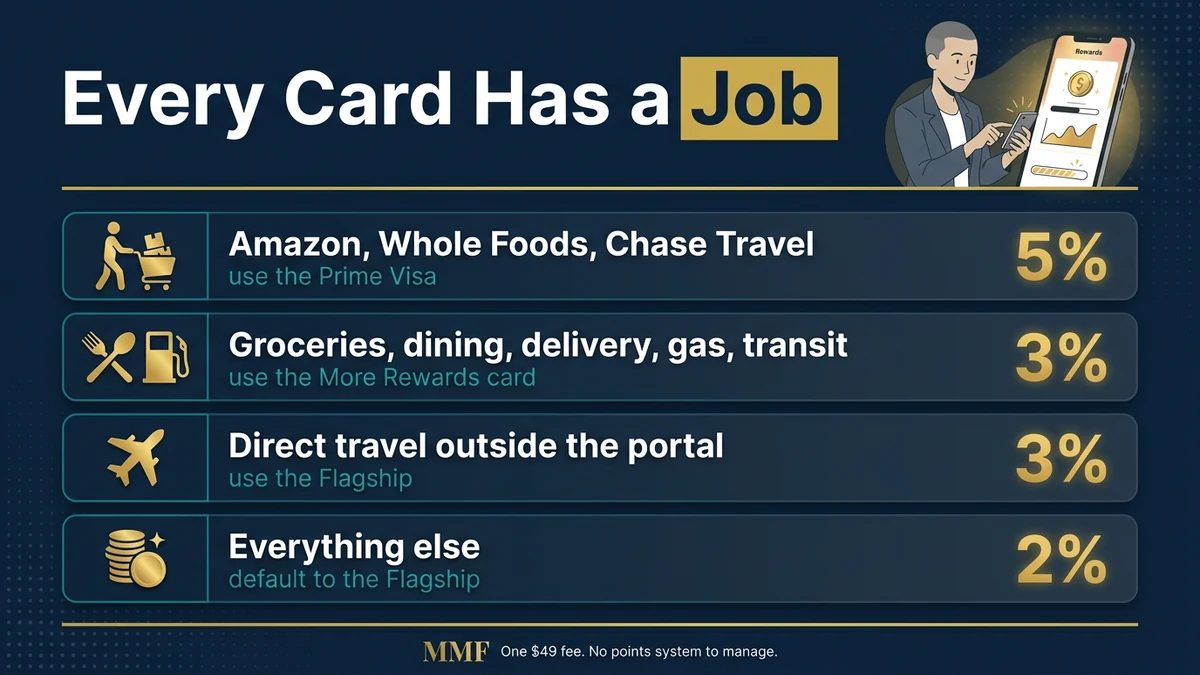
This is the part that separates a real stack from a pile of random cards. Every card here has a job. Here’s how you route your spending so nothing gets wasted.
- Amazon, Whole Foods, and Chase Travel go on the Amazon Prime Visa for 5% back.
- Any other grocery spend, plus all your dining, food delivery, gas, and transit, runs on the More Rewards card for 3% back.
- Direct travel you book outside the Chase portal goes on the Flagship for 3% back.
- Everything else defaults to the Flagship for 2% back.
No wasted cards, and every card has a job. That’s what a real stack looks like. And notice what you don’t have to do here: no transfer charts, no award availability roulette, no quarterly activation calendars. You swipe the right card, you earn, you move on. If you want that same simple-beats-complicated argument applied to the travel and points world, I made the full case in my Capital One vs Chase breakdown.
The math: a real monthly budget
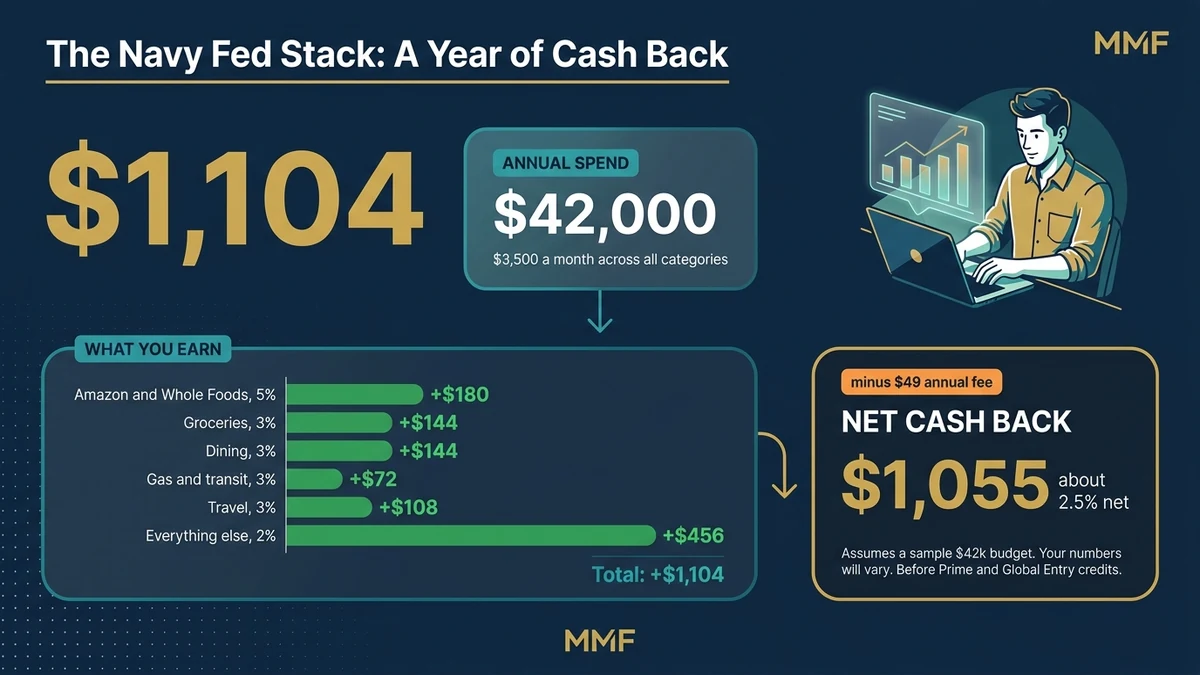
Alright, enough theory. Let’s run a sample budget and see how this actually shakes out on a normal month. We’ll assume $3,500 a month in total spend, which comes out to about $42,000 a year. And we’ll say that spend breaks down like this.
Assume $300 a month on Amazon and Whole Foods. At 5%, that’s $180 a year. Then $400 a month on regular groceries, which is another $144 at 3%. Another $400 a month on dining lands you $144 more at 3%. Say $200 a month on gas and transit, that’s $72 at 3%. Put $300 a month toward travel, and that’s $108 at 3%. Finally, $1,900 a month on everything else runs $456 a year at 2%.
So add all of that up and you land at about $1,104 a year in cash back on $42,000 in annual spend. Then subtract the $49 Flagship fee and you’re at roughly $1,055 a year in net value. That works out to about 2.63% gross and about 2.5% net after the fee.
$180 (Amazon at 5%) + $144 (groceries at 3%) + $144 (dining at 3%) + $72 (gas and transit at 3%) + $108 (travel at 3%) + $456 (everything else at 2%) = $1,104 a year. Minus the $49 fee is $1,055 net, or about 2.5% on $42,000 of spend.
Why your real return is probably higher
And here’s the part that makes that number conservative. That 2.5% net is before you factor in the Prime credit or the Global Entry and TSA PreCheck credit. If you’re someone who’d get real value out of those, your actual return climbs higher. Now, this is a hypothetical profile, so your numbers will land differently based on where your money actually goes. But run your own categories through it and you’ll see the shape holds.
That 2.5% assumes a spend split that probably isn’t yours. Shift more into groceries and dining and the return climbs. Most people I work with are leaving $300 to $800 a year on the table because their cards don’t match their real spend. If you want me to look at yours directly, book a Spend Audit ($97) and I’ll map the right setup to your numbers.
Where this stack loses
I’m not going to sell you a setup that’s perfect, because this one isn’t. If you’re a points maximizer chasing transfer partners or premium cabin redemptions, this strategy isn’t for you, and I’d rather say that plainly than pretend otherwise. These points don’t transfer to airlines or hotels. There’s no Hyatt sweet spot, no business-class-to-Europe play, no ceiling beyond that flat 1 cent per point. What you see is genuinely what you get.
For a travel hacker who lives for optimizing across a wallet full of premium cards with high fees and scattered credits, this stack is too simple to be interesting. And that’s completely fine. S tier for me could be a D tier setup for you depending on how you like to play the game. This is built for the person who wants an ultra-efficient cash back setup with a very low annual fee, not the person who treats points as a hobby.
The other honest limit is eligibility. If you don’t qualify for Navy Federal, this is a hard stop, full stop actually. No workaround. But even if you’re a die-hard optimizer who does qualify, I’d still take a look at the Flagship on its own. If you’re already paying for Prime, getting that covered on a roughly $50 fee card makes it a strong pickup for basically anyone.
Best for / Not for
Best for:
- People who qualify for Navy Federal and have just been sleeping on the cards
- Anyone already paying for Amazon Prime who’d rather have it covered by a card credit
- People who want 3% to 5% back without managing transfer partners, award charts, or a stack of credits
- Beginners who want a simple, predictable cash back setup they can run for years on autopilot
Not for:
- Anyone who doesn’t qualify for Navy Federal membership. This is a hard stop.
- Travel hackers chasing high-value transfer partner and premium cabin redemptions
- Optimizers who enjoy juggling multiple high-fee cards and their credit calendars as a hobby
- Anyone carrying a credit card balance. Pay that off before chasing any rewards.
Best Navy Federal credit cards FAQs
Is the Navy Federal Flagship Rewards worth it?
For most people who qualify, yes. It earns 3x on travel and 2x on everything else, and its Amazon Prime credit alone is worth about $139 a year against a $49 annual fee. If you already pay for Prime, the card nets positive before you earn a single point, and the Global Entry or TSA PreCheck credit stacks on top.
Do you have to be in the military to get a Navy Federal credit card?
No. Active-duty members, veterans, DoD employees, and contractors qualify, but so do their family and household members. A spouse, parent, grandparent, sibling, or even a roommate who served or works for the DoD can open the door for you. Confirm your exact situation at navyfederal.org.
Are Navy Federal rewards points worth anything?
They’re worth a flat 1 cent per point, which is exactly how this stack is valued. There are no airline or hotel transfer partners, so there’s no higher ceiling to chase. The upside is simplicity and zero devaluation risk. What you earn is what you get.
Is the Navy Federal More Rewards card worth it?
If you spend meaningfully on groceries, dining, gas, or transit, yes. It earns 3x on all of those with a $0 annual fee. The one catch is that it runs on the American Express network, so keep the Flagship handy for spots that don’t take Amex, especially abroad.
How do you become a Navy Federal member?
Once you confirm you’re eligible, open a shared savings account with a $5 minimum deposit. That gives you a member number, and from there you can apply for the credit cards. The $5 account is the entire barrier to entry.
If you want to see how these three stack up against everything else out there, the full Credit Card Reviews library runs through every card I’ve broken down.
The best Navy Federal credit cards aren’t flashy, and that’s the point. Stack the Flagship, the More Rewards, and the Amazon Prime Visa and you cover your whole budget at 3% to 5% back with a 2% catch-all. In practice, that’s a net fee of $49 that the Prime credit erases on its own, and around 2.5% net cash back before you even count those credits, with no points system to manage. If you qualify and you want real value without a second job, this is one of the most underrated setups in the space. If you don’t qualify, or you live to optimize transfer partners, keep scrolling. For everyone in between, give it a serious look.
Some links are affiliate links. I only recommend products I personally use or genuinely believe will help you. Terms apply. Pay your balance in full. Applying results in a hard inquiry. Bank bonuses are typically taxable income (1099-INT). Review all requirements. I’m not a financial advisor or CPA. This is personal experience and opinion.
Join the discussion
Prompt
What's your experience with this card or strategy? Share your numbers.
Be the first to share your numbers
Real datapoints from the comments make this thread more useful than another review post.
Leave a comment